

Food Safety Temperature Monitoring for HACCP and FSSAI Compliance
Ensuring Compliance, Safety, and Efficiency in Food & Beverage Operations
Ensure freshness, safety, and compliance across the supply chain with real-time IoT monitoring, predictive alerts, and optimized operations.
Key Benefits
- Ensure Product Freshness & Quality
- Achieve Regulatory Compliance
- Minimize Waste & Loss
- Optimize Operational Efficiency
- End-to-End Supply Chain Visibility
- Scalable & Flexible Solution
Perfect For
Food & Beverage Supply Chain Challenges
Identifying Risks and Optimizing Operations Across the Supply Chain
Perishable Goods Spoilage
Temperature fluctuations and delayed interventions lead to product loss.
Lack of Real-Time Visibility
Limited tracking across storage and transportation hinders timely corrective actions.
Regulatory Compliance Risks
Manual reporting increases the chance of non-compliance with food safety standards.
Inefficient Cold Chain Operations
Manual monitoring and logging increase labor costs and errors.
Multi-Site Coordination Challenges
Managing farms, warehouses, and distribution networks is complex without centralized oversight.
Equipment Downtime
Refrigerated storage and transport failures disrupt supply schedules and reduce product quality.
Use Cases
Perfect for various applications
Cold Storage Monitoring
Transportation & Delivery Monitoring
Farm-to-Fork Supply Chain
Multi-Site Food Distribution
Regulatory Compliance & Auditing
Predictive Maintenance for Refrigeration Units
Don't see your specific use case? We can customize a solution for you.
Discuss Your RequirementsSee Our Solutions in Action
Request a personalized demo tailored to your specific requirements
Key Features
Everything you need for comprehensive monitoring
Real-Time Environmental Monitoring
Continuous tracking of temperature, humidity, and other critical conditions in storage and transit.
Centralized Dashboard
Unified visibility across farms, warehouses, processing centers, and delivery fleets for easy management.
Automated Alerts & Notifications
Instant SMS, email, or app alerts for deviations in environmental conditions.
Predictive Maintenance
Early detection of refrigeration or equipment issues to prevent downtime and spoilage.
GPS Tracking & Route Monitoring
End-to-end visibility of shipments to ensure timely delivery and product integrity.
Audit-Ready Compliance Reporting
Automated reports support HACCP, ISO 22000, and local food safety standards.
Industry Standards & Compliance
Our solutions meet the highest industry standards and regulatory requirements
FDA 21 CFR Part 11
Electronic records and signatures compliance
ISO 9001:2015
Quality management systems certification
GMP/GxP
Good Manufacturing Practice compliance
HACCP
Hazard Analysis and Critical Control Points
Certified and Validated by:
Success Stories
See how our solutions drive real results
Fortune 500 Company
Food processors, Cold storage, Warehouses
Challenge:
A regional fresh produce distributor experienced high spoilage rates during transit and storage, resulting in financial losses and quality complaints.
Solution:
IoT-enabled temperature and humidity sensors were deployed in warehouses and delivery trucks, with real-time alerts and centralized dashboards.
Results:
- ✓30% reduction in spoilage across shipments
- ✓Improved compliance with food safety standards
- ✓Enhanced customer satisfaction due to consistent product quality
Trusted by leading pharmaceutical companies worldwide
HACCP in the food industry: critical control points and automatic records
HACCP asks a food business to identify its critical control points, set limits for each, monitor them and keep records that prove it. Temperature is the most common CCP: chilled storage, frozen storage, cooking, hot holding and cooling. Handwritten logs taken twice a day miss the night the compressor tripped. A logger recording every few minutes, with an alert when a limit is crossed and a report that shows the corrective action, turns HACCP temperature monitoring from a clipboard exercise into evidence.
The same data supports verification: reviewing a week of records shows which units run close to their limits, which doors are left open during deliveries and which compressors are starting to struggle, so maintenance can act before food is lost.
FSSAI temperature monitoring requirements
Schedule 4 of the FSSAI licensing and registration regulations sets out general hygiene and sanitary practices, and in practice auditors expect chilled and frozen food to be held at controlled temperatures, equipment to be monitored, and records to be kept and shown on request. Exact limits depend on the product category and your food safety plan, so treat this as guidance and confirm against your licence conditions. Our guide to FSSAI temperature monitoring requirements covers the detail.
Restaurant kitchen, cloud kitchen and dark store monitoring
Kitchens run many small refrigerators and freezers that nobody watches after closing. Wi-Fi WTH70 or 4G MTH70 loggers with an external probe inside each unit send an alert to the shift manager when a door is left open or a unit fails, and a daily report replaces the paper sheet on the fridge door. For chains, one dashboard shows every outlet.
Supermarket refrigeration monitoring
Supermarkets usually already have Dixell controllers on display cabinets and cold rooms. The CSC50T gateway reads those controllers over Wi-Fi, stores up to 30 days of data if the internet fails, and produces 21 CFR Part 11 compliant reports, so the store gets central monitoring without replacing refrigeration hardware. Other controllers with RS485 MODBUS can be connected through the CSC50R gateway.
Cold room temperature monitoring for dairy, meat and seafood
Dairy chillers, meat hanging rooms and seafood freezers need continuous monitoring with alerts that reach someone at night. The 4G MT120 works in plants with no Wi-Fi coverage in the cold store and covers -50°C to +120°C with an external probe. For transport from farm or landing centre, see our cold chain monitoring solutions.
Offline loggers for sites without Wi-Fi
Rural collection centres, small processors and seasonal stores may have no reliable network. The offline OTH70 records temperature and humidity locally and downloads over USB or a local Wi-Fi link, and the UT70 USB logger creates a PDF report on any computer. Records are still complete for the auditor, just collected rather than streamed.
Recommended data loggers
Models from the Ideabytes range suited to this solution.
Showing 7 products
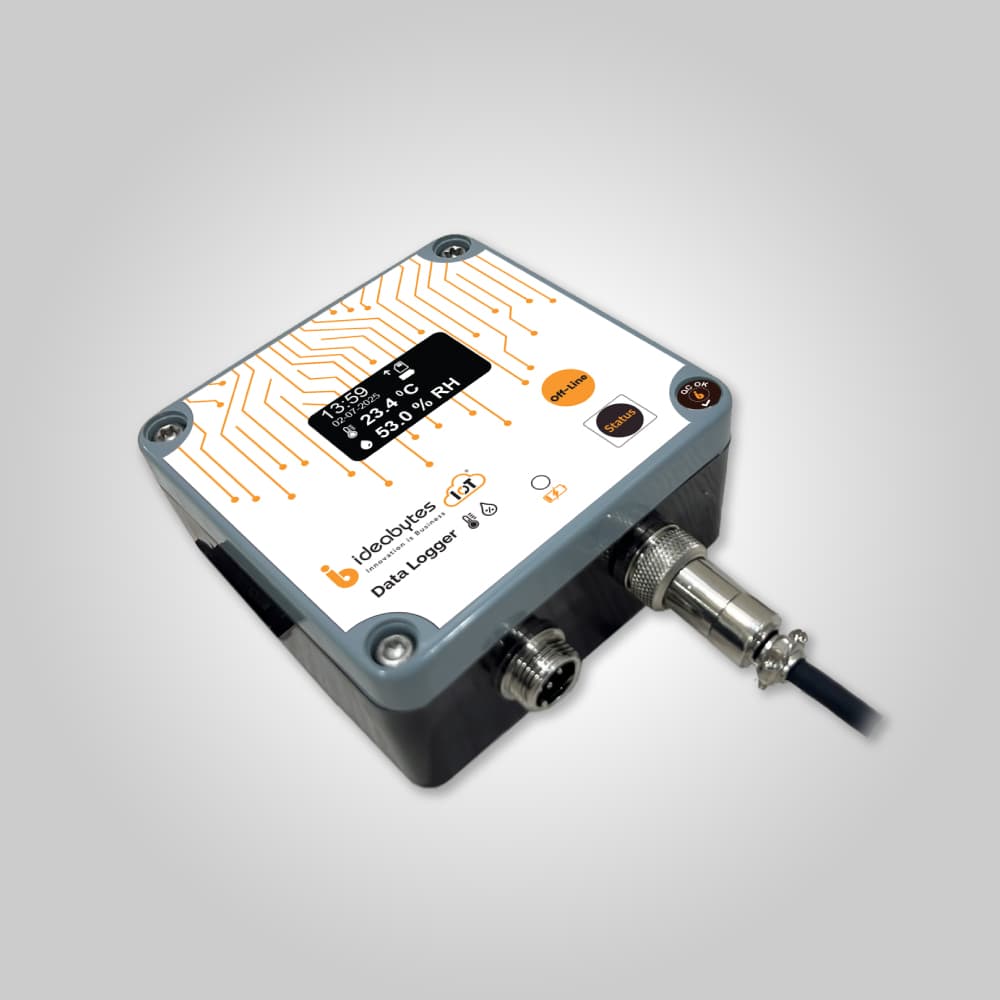
IBI-OTH70 | Offline Temperature & Humidity Data Logger
Measuring Range from -20°C to +70°C
- •±0.5°C accuracy
- •Plug & Play, Wall Mountable Device
- •Data Download Options (Wi-Fi / USB)

IBI-WTH70 | Wi-Fi Temperature & Humidity Data Logger 70
Measuring Range from -20°C to +70°C | Humidity from 0% RH to 99% RH (Non - Condensing)
- •Wi-Fi 802.11 b/g/n 2.4 GHz Connectivity
- •± 0.5°C (-10°C to +50°C) Accuracy

IBI-MTH70 | 4G M2M Temperature & Humidity Data Logger
Measuring Range from -20°C to +70°C | Humidity from 0% RH to 99% RH (Non - Condensing)
- •4G LTE Cat1/2G fallback
- •± 0.5°C (-10°C to +50°C) Accuracy

IBI-UT70 | USB Temperature Data Logger
Measuring Range from -30°C to +70°C
- •Battery life up to 90 days
- •Software for configuration
- •Replaceable battery

IBI-CSC50T | Wi-Fi Dixell Interfacing Gateway
Wi-Fi Dongle for Dixell Controller
- •Maximum of 20 parameters can be monitored based on requirement
- •Custom Reports (21CFR Part 11 Compliant) PDF, CSV, Excel

IBI-CSC50R | Wi-Fi RS485 MODBUS Interfacing Gateway
8 Default Parameters (Configuration Charges additional)
- •Can Communicate up to 15 RS-485 MODBUS RTU enabled Devices
- •Maximum of 30 parameters can be monitored based on requirement (Single or Multiple RS485 Devices)

IBI-MT120 | 4G M2M Temperature Data Logger
Measuring Range from -50°C to +120°C
- •4G LTE Cat1/2G fallback Connectivity
- •± 0.5°C (-10°C to +50°C) Accuracy
Frequently asked questions
How often should HACCP temperature records be taken?
Your HACCP plan sets the frequency for each critical control point, but manual checks twice a day leave long gaps. An automatic logger recording every few minutes captures every excursion, including overnight, and flags it with an alert. Keep the reports with your corrective action records so the auditor can see what was done.
Does FSSAI require a digital temperature monitoring system?
FSSAI expects temperatures to be controlled, monitored and recorded; it does not mandate a particular method. Paper logs are accepted if they are complete, but digital loggers remove gaps and handwriting disputes, and give an auditor a tamper-evident record. Check the conditions of your own licence and food safety plan.
Can I monitor supermarket refrigeration without replacing the controllers?
Yes. If your cabinets and cold rooms use Dixell controllers, the CSC50T Wi-Fi gateway reads them directly and sends the data to the dashboard. Controllers with RS485 MODBUS can connect through the CSC50R gateway. No refrigeration hardware needs to change.
How much does food safety temperature monitoring cost?
It depends on the number of refrigerators, freezers and cold rooms, whether they need probes or controller gateways, and whether the site has Wi-Fi. Share your outlet list and equipment count through the contact form and we will send a quote.
Related reading
Ready to Transform Your Operations?
Get started with our comprehensive IoT monitoring solutions today