
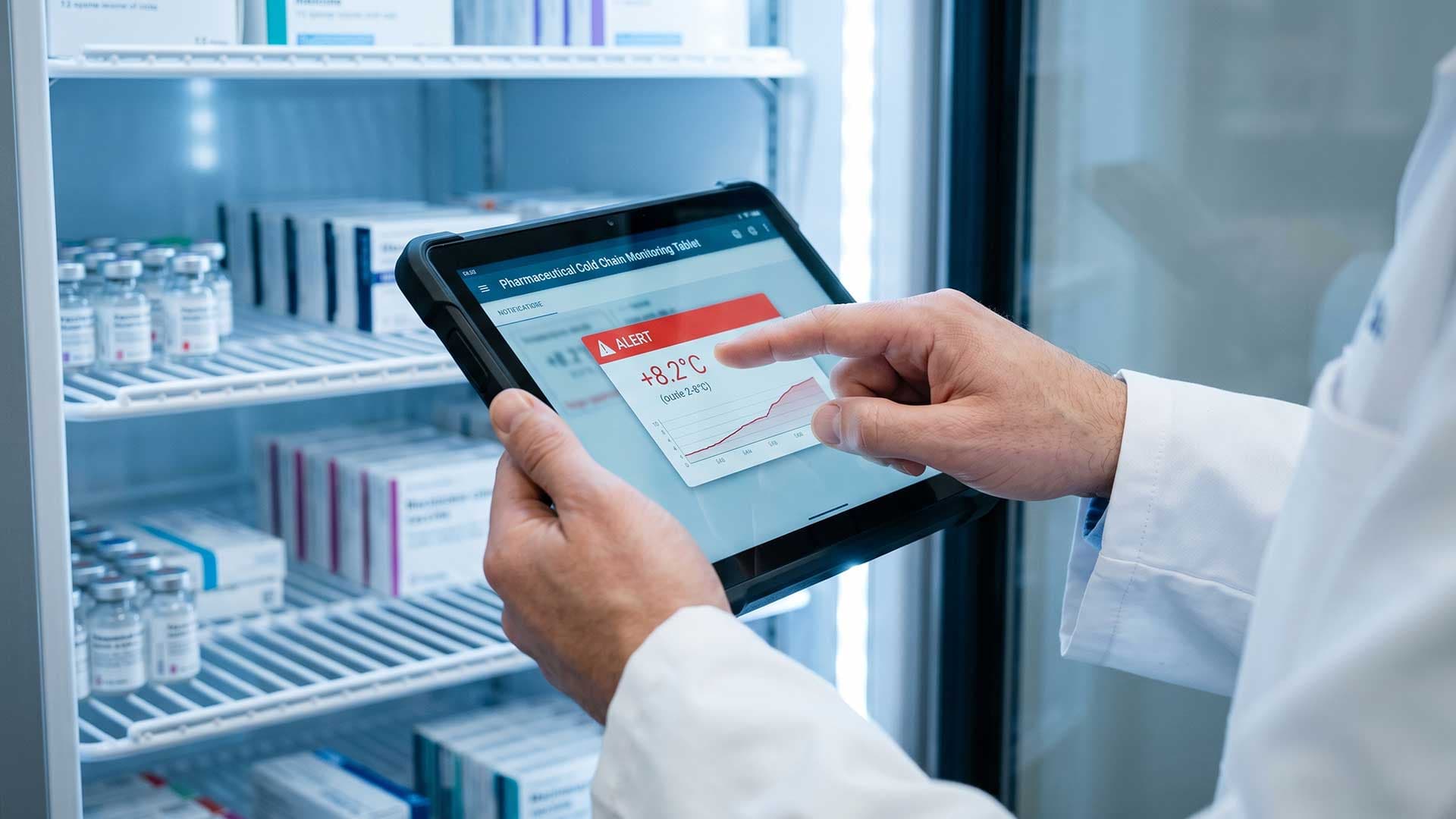
The $35 Billion Question: Why Real-Time Excursion Alerts Are Pharma's Highest-ROI IoT Investment
Every hour a pharmaceutical product sits outside its validated temperature window, value evaporates. IQVIA and industry analysts estimate that roughly $35 billion in pharmaceutical product is lost each year to cold-chain temperature excursions counting lost product, replacement clinical trial doses, logistics waste, and root-cause investigation costs. For supply-chain leaders weighing the cost of an IoT logger fleet against the price of inaction, the math is no longer subtle: real-time temperature excursion alerts pharma teams trust have become the highest-leverage line item on the cold-chain budget.
Why Excursions Cost So Much: The Per-Shipment Reality
The aggregate $35B figure can feel abstract until it lands on a single shipment. The pharmaceutical cold-chain logistics market reached approximately $22.75 billion in 2025 and is projected to nearly double to $44.1 billion by 2033, driven by biologics growth. Biologics already account for around 30% of prescription drug sales and more than 85% require temperature-controlled storage end-to-end. That concentration means a single high-value pallet of monoclonal antibodies can carry north of $1 million, while a mishandled cell or gene therapy run can exceed $500,000 per patient dose.
WHO data referenced widely across the industry indicates up to 50% of vaccines may be wasted globally each year due to cold-chain breakdowns, with around 25% arriving degraded. Published industry temperature-excursion rates run between 7% and 9% globally, climb to roughly 12% in some recent figures, and reach 20–30% on lanes serving the developing world. The exposure is not a tail risk; it is a recurring operating cost.
The Detection-Time Problem That Manual Logs Cannot Solve
Traditional chart recorders and twice-daily clipboard logs deliver only two data points across the 1,440 minutes in a day. Excursions surface "hours or days late," long after the product has degraded. By contrast, IoT real-time alerting platforms drive mean time to detection (MTTD) down to roughly 15 minutes, versus 15+ hours for manual workflows, and capture between 96 and 288 readings per asset per day.
Why does that gap matter financially? WHO stability research shows certain vaccines lose meaningful potency after only 2–4 hours above 8°C. A manual detection window almost always misses the save-rate threshold, while a 15-minute alert window leaves room for a courier diversion, a generator restart, or a re-icing intervention that converts a write-off into a rescue. That single behavioral change — turning passive logging into active alerting — is the ROI engine.
Building the Alerting Backbone: Three Ideabytes Models That Anchor the Stack
Ideabytes engineers a tiered pharma monitoring stack so that every storage node and every transport leg send data to the same cloud, with the same alert engine and the same 21 CFR Part 11 record format. The three workhorse SKUs below cover the typical 2°C–8°C distribution lane, ultra-low and high-temperature use cases, and centralized facility monitoring.
IBI-MTH120 — 4G M2M Temperature & Humidity Data Logger
The IBI-MTH120 is the in-transit alerting workhorse for pharmaceutical and biologic distribution. It uses 4G LTE CAT1 with an in-built M2M SIM, eliminating dependence on warehouse Wi-Fi or driver hotspots. With a measuring range of -40°C to +120°C and ± 0.5°C accuracy from -10°C to +50°C, it covers vaccine, insulin, monoclonal antibody, and ambient-controlled lanes from a single SKU. It carries an FDA 21 CFR Part 11, CE, FCC, and IC compliance profile, ISO 9001:2015 and ISO/IEC 27001:2022 certification, and is built for an operating envelope of -40°C to +85°C.
IBI-MT350 — 4G M2M Temperature Data Logger for Extreme Ranges
For ultra-low-temperature and high-temperature applications, the IBI-MT350 extends the monitoring range to -200°C to +350°C, the IBI-MT350 extends the same alerting fabric to a -200°C to +350°C measuring range. It uses 4G LTE Cat1 with 2G fallback, which is critical on rural distribution lanes where 4G coverage is patchy and a missed alert is the difference between a saved and lost shipment. Accuracy is ± 0.5°C across -10°C to +50°C, and the device shares the same FDA 21 CFR Part 11, CE, FCC, and IC compliance profile as the rest of the Ideabytes line.
IBI-CSC50T — Wi-Fi Dixell Interfacing Gateway
Where pharmaceutical cold rooms or refrigeration systems use compatible Dixell controllers, the IBI-CSC50T provides a Wi-Fi interface for collecting controller data.. Rather than ripping and replacing, the IBI-CSC50T attaches as a Wi-Fi dongle, exposes up to 20 monitored parameters, and pushes the same data into the Idea bytes cloud as the in-transit loggers. Crucially, it generates 21 CFR Part 11-compliant custom reports in generates custom reports in PDF, CSV and Excel formats. Compliance: FDA 21 CFR Part 11, CE, FCC, IC; certifications include ISO 9001:2015, ISO/IEC 27001:2022, ISO/IEC 27017:2015, VAPT, GEM, and RITES Approved OEM.
Putting Numbers on the ROI Calculator
Real-time alerts produce return through three interlocking levers: prevented product loss, avoided investigation cost, and avoided regulatory penalty.
ROI Lever | Per-Event Value | How Real-Time Alerts Capture It |
|---|---|---|
Prevented product write-off | $500K–$1M+ per high-value shipment | 15-min MTTD allows courier diversion or re-icing before potency loss at 2–4 hours |
Avoided root-cause investigation | >$50K per major excursion event | Continuous 96–288 readings/day provide an audit-ready timeline, no forensic reconstruction |
Avoided recall / penalty | Variable leading cause of FDA citations | Node-by-node temperature record with 2-year retention satisfies 24–48 hour FDA records request |
Reduced spoilage on emerging-market lanes | 20–30% excursion rate baseline | 4G M2M connectivity (IBI-MTH120, IBI-MT350) maintains visibility where Wi-Fi is unreliable |
The arithmetic is consistent. A single avoided $500K shipment loss covers a logger and gateway fleet deployment several times over. For high-value biologic lanes, payback often happens on the first prevented excursion. For standard 2–8°C distribution, a 12-month payback window is realistic well inside the depreciation life of the hardware.
The Regulatory Tailwind: 2026 Tightening Makes Alerting Mandatory in Practice
Even firms that try to defer the investment are running out of room. FDA and EMA frameworks already require detailed end-to-end real-time temperature data, with 24–48 hours to produce records on demand; missing the window triggers recall risk and penalties. The January 2026 enforcement update tightens this further: temperature must be tracked at every node storage, transfer, and cross-dock with two-year record retention. Cold-chain failures remain a leading cause of regulatory citations and product recalls, and 21 CFR Part 11 data-integrity standards apply to every monitoring record, manual or electronic.
This is where the Ideabytes stack converts compliance pressure into operating leverage. The IBI-CSC50T's PDF, CSV, and Excel custom reports map directly to what auditors request. The IBI-MTH120 and IBI-MT350 timestamp every reading at the device with cellular-backed delivery so there is no gap between the freezer in Mumbai and the cross-dock in Singapore. Two-year retention is a cloud setting, not a filing-cabinet exercise.
How a 4G + Gateway Pair Eliminates Blind Spots
The architectural insight behind the ROI is that no single device closes every gap. A facility-only gateway leaves transit blind. A transit-only logger leaves the receiving freezer blind. The pairing below is the pattern most pharma operators converge on:
In-transit alerting (IBI-MTH120): Travels with the pallet from manufacturer to distribution centre. 4G LTE CAT1 with M2M SIM means the courier does not need to install or authenticate anything. The device provides temperature and humidity monitoring for applications where both parameters need to be tracked.
Extreme-temperature lanes (IBI-MT350): Drops into ultra-cold or high-temperature lanes where the standard 2–8°C device cannot measure. Its -200°C to +350°C measurement range supports applications requiring monitoring across ultra-low and high-temperature conditions, with the same alert routing as the 2–8°C fleet.
Fixed-site facilities (IBI-CSC50T): Plugs into existing Dixell-controlled cold rooms and pushes the same data shape to the same dashboard. Up to 20 parameters can be monitored based on the application requirements, allowing relevant refrigeration-controller data to be brought into the monitoring platform, all of which feed root-cause investigation when they happen.
Because every device shares the same compliance posture (FDA 21 CFR Part 11, CE, FCC, IC) and theThe Ideabytes platform supports a common compliance and monitoring approach across these devices, with applicable certifications and controls documented for each product.
Adoption Has Already Crossed the Tipping Point
Industry surveys now indicate roughly 69% of Pharma firms have adopted automated real-time cold-chain monitoring. The remaining minority are increasingly the lanes flagged in audits and the candidates for the next high-profile recall. The competitive question is no longer whether to deploy real-time alerting — it is which platform delivers the lowest MTTD, the cleanest 21 CFR Part 11 record, and the broadest connectivity coverage from cold storage to the last mile.
Conclusion: One Prevented Excursion Funds the Fleet
The financial story of pharma cold chain in 2026 is the gap between two numbers: the 15-hour manual detection window that turns excursions into write-offs, and the 15-minute IoT detection window that turns them into rescues. With biologics expanding, regulators tightening node-level requirements, and per-shipment exposure climbing into the $500K–$1M range on premium lanes, real-time temperature excursion alerts are no longer a nice-to-have analytics layer — they are the primary loss-prevention control on the balance sheet.
The Ideabytes IoT stack — IBI-MTH120 for 4G in-transit alerting, IBI-MT350 for extreme-range and remote lanes, and IBI-CSC50T for fixed-site Dixell-equipped cold rooms — is purpose-built to compress that detection window, satisfy FDA 21 CFR Part 11 record requirements, and deliver payback on the first prevented excursion. For supply-chain leaders modeling 2026 capex, the cleanest ROI in the cold chain starts with a single decision: stop logging temperature, start alerting on it.