
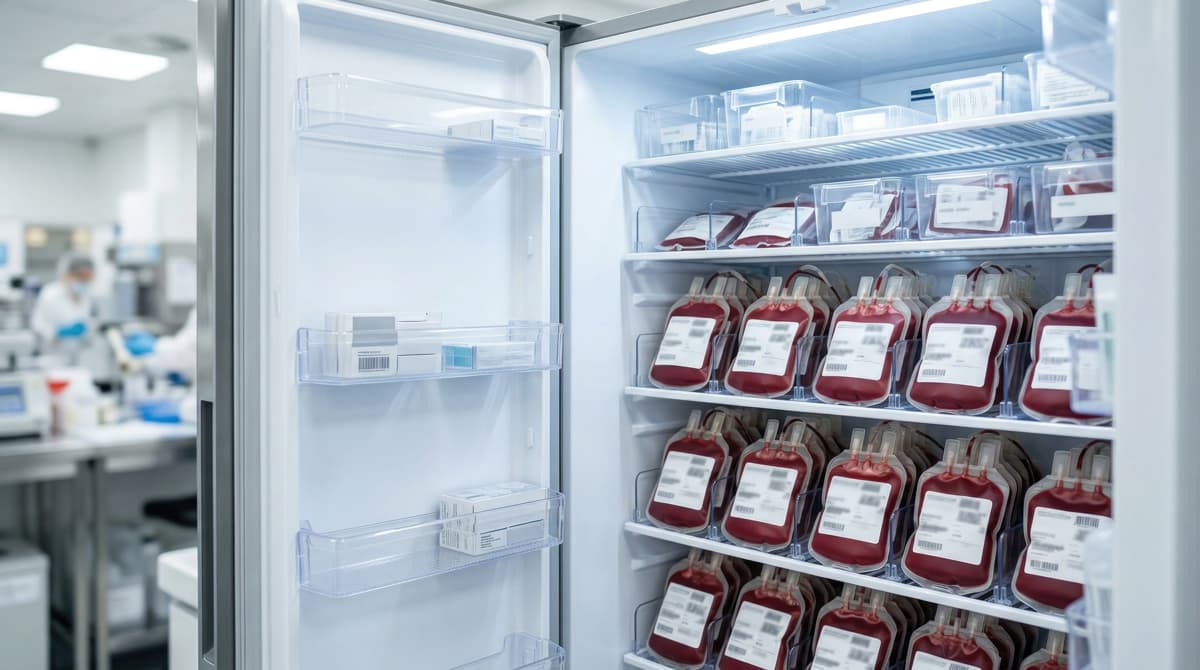
When a Single Temperature Excursion Can Erase a 60-Unit Blood Refrigerator Overnight
Blood banks and hospital pharmacies operate the most unforgiving cold storage in healthcare. A liquid red blood cell unit must hold between 1°C and 6°C, fresh frozen plasma must stay at ≤ -18°C, and platelets must agitate continuously at 20°C to 24 °C. A single overnight excursion in an unattended walk-in fridge can quietly compromise dozens of irreplaceable units before a tech walk in at 7 AM. This is exactly the failure mode that 24/7 IoT-based blood bank temperature monitoring is engineered to eliminate, and the stack that solves it for pharmaceutical cold chains is the same stack hospitals are now adopting for AABB, USP and CAP compliance.
The Regulatory Reality: Continuous Monitoring Is Not Optional
The compliance picture for hospital cold storage is dense and prescriptive. AABB Standard 5.1.8 requires every piece of equipment used to store blood and components to have a system that continuously monitors temperature with an audible alarm that activates before contents reach unacceptable limits. The FDA reinforces this in 21 CFR 606.60(b)(3), which mandates temperature recorders on blood storage refrigerators and freezers, and 21 CFR 606.160 requires those temperature records be retained as part of the regulated quality record.
Hospital pharmacies face a parallel set of obligations. USP General Chapter <797> defines compounded sterile preparation storage at refrigerator 2°C to 8°C and freezer -25°C to -10°C, and requires temperature monitoring at least daily, documented through either daily checks or a continuous recording device. The 2023 revision of USP <797> explicitly requires monitoring devices to be calibrated, with calibration results documented, and any excursion investigated. USP <800> adds that hazardous drug refrigerators must be monitored to maintain manufacturer-specified temperatures, while USP <1079.4> expects formal temperature mapping of every cold storage unit before routine continuous monitoring begins. Layered on top, CAP Laboratory General Checklist item COM.30750 demands that every temperature-dependent storage device be monitored and recorded with a calibrated thermometer per a written SOP, and that automated systems give personnel ongoing immediate access to data for corrective action.
The Joint Commission ties this together at the facility level: EC.02.05.01 governs utility-system risk for refrigerators and freezers, and MM.03.01.01 requires a process that ensures medication storage stays within required ranges. None of these standards prescribe a specific brand or technology, but together they make manual paper logs and standalone analog thermometers a high-risk strategy in any modern facility.
What the Failure Mode Looks Like in Practice
The cost of getting this wrong is well documented. A widely cited HHS Office of Inspector General study of CDC's Vaccines for Children program found that 76 percent of audited providers had exposed vaccines to improper temperatures for more than five cumulative hours during a two-week study window. The CDC has separately estimated that temperature excursions compromise more than 20 million dollars of vaccines per year in the United States alone. In transfusion medicine, peer-reviewed analyses of inter-hospital red blood cell redistribution programs identify temperature failures as the leading cause of unit discard, and ASPR-TRACIE has documented repeated post-hurricane episodes where power loss and equipment failures forced facilities to file FDA Biological Product Deviation Reports under 21 CFR 606.171 for storage temperature excursions affecting released units.
Most of these incidents share a profile: an after-hours equipment fault, a delayed human discovery, and a cascade of paperwork that begins only after the inventory is already lost. A representative scenario at a 400-bed regional hospital might involve a blood bank with two upright transfusion-grade refrigerators (1 to 6 degrees C), one minus 30 degrees C plasma freezer, a USP <797> pharmacy compounding refrigerator, and a USP <800> hazardous drug refrigerator in a negative-pressure room. That is at least five cold storage units, each with multiple zones, each requiring continuous monitoring, calibrated probes, and documented alarm response. A single platform that handles all of them is the practical goal.
The IoT Stack: PT100 Probes, Wi-Fi Sensors, and a Compliance Gateway
For the representative scenario above, three Ideabytes products map cleanly onto the requirements:
IBI-WTR4 — Wi-Fi 4-Channel PT100 Temperature Data Logger. With a measuring range of -200°C to 550°C across both PT100 and optional PT1000 inputs and an accuracy of 0.5°C (0.05 % of full scale), the IBI-WTR4 is the right tool for blood storage and plasma freezers where mapping requires multiple probe positions per unit. Four independent PT100 channels mean a single logger can monitor top-shelf, mid-shelf, bottom-shelf and door zones of one transfusion refrigerator, or instrument two adjacent units. The 2.4-inch 128x64 OLED graphical display gives staff an at-a-glance reading at the equipment, and Wi-Fi 802.11 b/g/n 2.4 GHz connectivity sends every reading to the cloud audit trail.
IBI-WTH120 — Wi-Fi Temperature and Humidity Data Logger. With a measuring range of -40 to 120°C, humidity from 0% to 100% percent RH (condensing), and 0.5°C accuracy from -10°C to 50°C, the IBI-WTH120 is suited to ambient compounding rooms, USP <800> hazardous drug storage rooms, and platelet incubator areas where both temperature and humidity must be tracked. The same 2.4 GHz Wi-Fi connectivity keeps deployment uniform across the facility, simplifying network whitelisting and IT review.
IBI-CSC50T — Wi-Fi Dixell Interfacing Gateway. Many transfusion-grade and pharmacy-grade refrigerators ship with Dixell controllers from the factory. The IBI-CSC50T speaks directly to those controllers, can monitor up to 20 parameters per unit, and produces 21 CFR Part 11-compliant custom reports in PDF, CSV, and Excel formats. Instead of bolting an external probe to a refrigerator that already measures itself, the gateway pulls native controller data for setpoint, evaporator temperature, defrost state, door alarm, and compressor health.
All three devices share Ideabytes hardened compliance posture: FDA 21 CFR Part 11, CE, FCC and IC, plus an operating range of -40°C to 85°C. Each is built on an ISO 9001:2015, ISO/IEC 27001:2022 and ISO/IEC 27017:2015 foundation with VAPT testing applied to the cloud platform, which is the level of evidence audit teams expect when reviewing electronic record systems.
Mapping, Calibration and the Validation Workflow
A defensible deployment follows the USP <1079.4> sequence: temperature mapping first, then routine continuous monitoring. Multiple PT100 probes are placed at warmest, coldest and average locations inside each unit, run for a minimum 24 to 72 hour mapping cycle through normal door-opening patterns, and the resulting data is reviewed against the manufacturer-specified range. The IBI-WTR4's four-channel PT100 architecture is purpose-built for this step because mapping requires synchronized multi-point capture from a single time-stamped instrument.
Once mapping is complete, two probes typically remain in service per unit (one at warmest location, one near the controller for cross-check), and calibration certificates are filed in the equipment record. CAP COM.30750 requires those certificates be available for inspection, and the cloud platform stores the digital trail alongside live telemetry so the entire history is reproducible from a single audit screen.
The 24/7 Alert Escalation Tree
Continuous data without alerting is just a logbook. The compliance and patient-safety value comes from how fast a temperature drift converts into a human action. A typical hospital escalation tree looks like this:
Pre-alarm: a soft warning fires when a probe drifts past a deadband threshold but before the AABB or USP excursion limit is breached. This gives the on-call team a chance to intervene before any product is at risk.
Hard alarm: SMS, email and voice notifications go to the on-call pharmacist or blood-bank technician.
Escalation: an unacknowledged alarm re-pages the charge nurse and biomedical engineering after a 5 to 10 minute window.
Documentation: every event, every acknowledgment and every corrective action is captured in a Part 11-compliant audit log, ready for regulator review.
For released blood units affected by an excursion, the FDA pathway is unambiguous: a Biological Product Deviation Report must be filed under 21 CFR 606.171. A platform that produces a complete time-stamped record of the excursion, the response, and the affected lot numbers makes that filing straightforward instead of forensic.
Why a Unified Stack Beats Single-Use Devices
Hospitals often inherit a patchwork: chart recorders on the blood-bank fridges, a different brand of probe in the IV room, a paper log in the hazardous-drug pharmacy. Each system is its own audit interview. By contrast, deploying the IBI-WTR4 for high-precision PT100 zones, the IBI-WTH120 for ambient and humidity-sensitive rooms, and the IBI-CSC50T as a controller-level integration point produces a single dashboard with one calibration register, one alarm policy, and one set of 21 CFR Part 11 reports. The same architecture used by pharmaceutical distribution centers for cold chain compliance scales naturally into transfusion services, hospital pharmacies, and adjacent USP <800> workflows.
Practical Deployment Checklist
Inventory every cold storage unit and classify by required range (1°C to 6°C, -18°C plasma, 20°C to 24°C platelet, 2°C to 8°C CSP, USP <800> HD).
Specify probe count per unit based on USP <1079.4> mapping requirements, and choose IBI-WTR4 channels accordingly.
Use IBI-WTH120 for any room or cabinet where humidity is part of the storage spec.
Use IBI-CSC50T to interface with existing Dixell-controlled equipment rather than adding redundant probes.
Define alarm thresholds with deadband and pre-alarm offsets aligned to AABB Standard 5.1.8.
Build a written escalation SOP referencing TJC EC.02.05.01 and MM.03.01.01.
Schedule annual probe calibration and retain certificates for CAP COM.30750.
Closing the Loop on Hospital Cold Storage Compliance
Blood bank and hospital pharmacy temperature monitoring sits at the intersection of patient safety and regulated record-keeping. The hardware needed to satisfy AABB, FDA, USP <797>, USP <800>, CAP, and Joint Commission requirements is not exotic, but it does need to be precise, validated, networked, and continuously monitored with auditable alarms. The combination of the IBI-WTR4 PT100 logger, the IBI-WTH120 Wi-Fi temperature and humidity logger, and the IBI-CSC50T Dixell gateway gives a hospital one consistent way to instrument every cold storage unit, generate Part 11-grade reports, and ensure that no overnight excursion goes undetected. To explore how this stack can be specified for your facility, contact the IdeaBytes team for a deployment scoping conversation.