WHO PQS E006
WHO PQS Vaccine Data Loggers & Cold Chain Monitoring Devices
WHO PQS (Performance, Quality and Safety) is the World Health Organization system that sets specifications for, and prequalifies, the cold chain equipment used in immunisation programmes. Its E006 category covers temperature monitoring devices: 30-day temperature recorders, freeze indicators, programmable loggers and remote temperature monitoring devices (RTMDs). UNICEF, Gavi-supported and state health department tenders often cite E006 specifications. This page is for immunisation officers, cold chain managers and suppliers preparing tender responses. It explains each device type, what an RTMD must deliver and what to submit, and how Ideabytes 4G loggers, designed to meet E006 RTMD requirements, fit ILR and deep-freezer monitoring.
- GeM registered
- 21 CFR Part 11 reports
- Made in India
| Device type | What it is | When it is typically required |
|---|---|---|
| 30-day temperature recorder (30DTR, fridge-tag style) | Battery device kept inside a refrigerator or freezer that shows the current temperature and a 30-day alarm history on its own display. | Every vaccine refrigerator and freezer at facility level where no remote monitoring is installed; read at each twice-daily check. |
| Remote temperature monitoring device (RTMD) | Continuously logs temperature and sends data and alarms over a mobile network or Wi-Fi to supervisors, keeping data on board during outages. | National, state and district vaccine stores, walk-in cold rooms and freezer rooms, and any site where excursions must be seen without a visit. |
| User-programmable temperature data logger | Records at a set interval for later download to a PC; no live alarm to remote staff. | Temperature mapping studies, vaccine transport and shipments between stores. |
| Electronic freeze indicator | Single-purpose indicator that shows whether vaccine has been exposed to freezing temperatures. | Transport and storage of freeze-sensitive vaccines in cold boxes and vaccine carriers. |
| Integrated or stem thermometer | Shows only the current temperature for manual recording. | Minimum fallback where no logger is fitted; programmes are replacing it with 30DTRs and RTMDs. |
What WHO PQS is and why tenders cite it
WHO PQS publishes performance specifications and verification protocols for immunisation equipment, from refrigerators and cold boxes to the devices that monitor them. Equipment that passes laboratory verification is listed in the PQS catalogue. Because UN agencies and many national programmes buy against these specifications, WHO PQS is shorthand in tenders for a known minimum standard of accuracy, alarm behaviour, battery life and robustness.
Tender documents use PQS in two ways. Some require a prequalified model by catalogue code. Others ask for devices that meet the E006 specification without demanding catalogue listing, so that locally made equipment can compete on performance. Read the clause carefully before you prepare a bid: the evidence you submit is different in each case.
Remote temperature monitoring device (RTMD) requirements for vaccines
An RTMD earns its place by making excursions visible in time to save the vaccine. Programme specifications typically expect:
- Continuous logging at a fixed interval, with every reading time-stamped
- Alarms for high and low temperature, sent to named people by SMS, app or call, with escalation
- Mobile network connectivity (4G with 2G fallback) where facilities have no reliable Wi-Fi
- On-board storage so that no data is lost when the network drops, with automatic upload afterwards
- Battery backup that keeps logging and alarming through power cuts
- A dashboard for supervisors and exportable reports for audits and programme reviews
Vaccine cold chain monitoring devices for ILRs, deep freezers and cold rooms
Ice-lined refrigerators (ILRs) and walk-in coolers hold most vaccines at +2 to +8 °C, while deep freezers and walk-in freezers keep ice packs and some vaccines at around -15 to -25 °C. A few newer vaccines need ultra-cold storage well below -60 °C. The monitoring probe must cover the full range with margin, and the alarm limits must match the equipment.
Ideabytes loggers cover all three. The MT120 (-50 to +120 °C) suits ILRs and deep freezers. The MT350 and OT350, with PT100 probes rated -200 to +350 °C, cover ultra-cold freezers. The MTH70 adds humidity for vaccine store rooms and dry stores, and the MT70 combines temperature with GPS for vaccine vans. Where a store already has dependable Wi-Fi, the WT350 offers the same PT100 range over Wi-Fi.
30-day temperature recorder vs RTMD: choosing the right device
The two devices answer different questions. A 30DTR tells the health worker standing at the refrigerator whether anything went wrong in the last month. An RTMD tells the cold chain officer, wherever they are, that something is going wrong now. Facility-level refrigerators in programmes with limited budgets usually start with 30DTRs; stores holding thousands of doses, and sites that are not staffed around the clock, justify remote monitoring.
Many programmes now combine them: an RTMD on every cold room and the larger ILRs and freezers, with 30DTRs on smaller units. When you plan, list each piece of equipment with its temperature range, location, power reliability and network coverage. That list decides which device goes where, and it is the first thing we ask for when sizing a proposal.
What to submit in a GeM or UNICEF tender for vaccine temperature loggers
Evaluation committees reject bids for missing paperwork more often than for performance. A complete technical bid usually contains:
- Datasheet and product brochure for each model offered (downloadable from each product page)
- NABL-traceable calibration certificates for the units supplied (available on request)
- Compliance statements for CE, FCC and IC and for 21 CFR Part 11 compliant reports (available on request)
- GeM registration and OEM credentials: Ideabytes IoT is GeM registered and a QCI-approved OEM
- For SIM-based loggers, the M2M connectivity arrangement; Ideabytes is a DOT-approved M2M service provider
- Warranty, installation, training and service terms, and a statement of compliance against each tender clause
How Ideabytes 4G loggers are positioned for vaccine programmes
Ideabytes 4G M2M loggers are designed to meet WHO PQS E006 RTMD requirements. The MT120, MT350 and MTH70 carry a built-in M2M SIM on 4G LTE with 2G fallback, store 90 days of readings at a 15-minute interval if the network is lost, and run for up to 20 hours on the internal battery during power cuts; the GPS-enabled MT70 uses LTE Cat-M1 and suits vehicles. Readings reach web and mobile apps with live alerts, app push notifications and optional SMS, and the platform produces 21 CFR Part 11 compliant PDF reports, alarm logs and MKT values.
Ideabytes does not claim WHO PQS prequalification for any model on this page. If your tender demands a PQS-catalogued device, check the current PQS catalogue; if it asks for devices that meet the E006 performance specification, share the clauses and we will respond point by point with supporting documents.
Loggers with WHO PQS E006 support
Every listed model produces tamper-evident, audit-ready reports from the Ideabytes cloud.
Showing 6 products

IBI-MT350 | 4G M2M Temperature Data Logger
Measuring Range from -200°C to +350°C
- •4G LTE Cat1/2G fallback Connectivity
- •± 0.5°C (-10°C to +50°C) Accuracy
IBI-MT120 | 4G M2M Temperature Data Logger
Measuring Range from -50°C to +120°C
- •4G LTE Cat1/2G fallback Connectivity
- •± 0.5°C (-10°C to +50°C) Accuracy

IBI-MTH70 | 4G M2M Temperature & Humidity Data Logger
Measuring Range from -20°C to +70°C | Humidity from 0% RH to 99% RH (Non - Condensing)
- •4G LTE Cat1/2G fallback
- •± 0.5°C (-10°C to +50°C) Accuracy
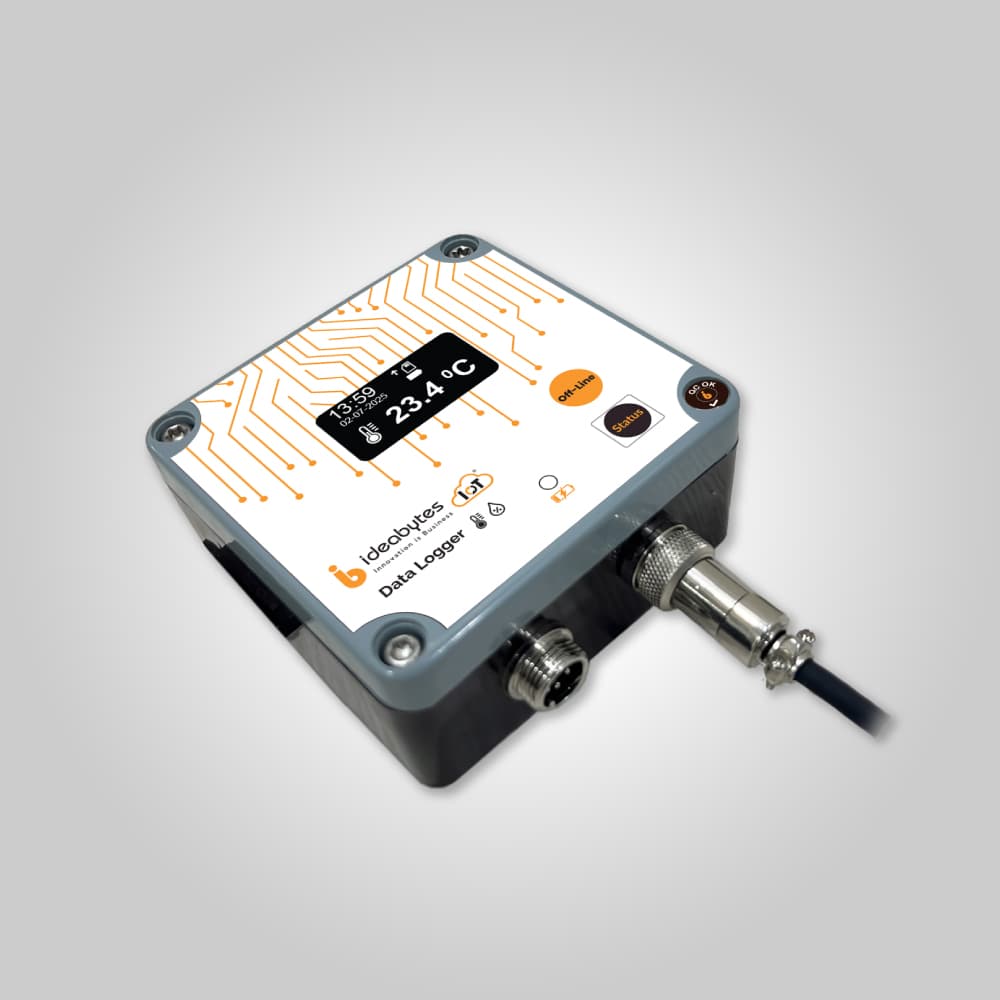
IBI-OT350 | Offline Single Channel Temperature Data Logger
Measuring Range from -200°C to +350°C
- •±0.5°C accuracy
- •Plug & Play, Wall Mountable Device
- •Data Download Options (Wi-Fi / USB)
IBI-MT70 | 4G M2M GPS Temperature Data Logger
Measuring Range from -30°C to +70°C
- •4G LTE Cat-M1 / GPS Connectivity

IBI-WT350 | Wi-Fi Temperature Data Logger
Measuring Range from -200°C to +350°C
- •Wi-Fi 802.11 b/g/n 2.4 GHz Connectivity
- •± 0.5°C (-10°C to +50°C) Accuracy
Logger types
Other compliance and buyer guides
Frequently asked questions
What is WHO PQS E006?
E006 is the WHO PQS product category for temperature monitoring devices used in immunisation supply chains. It includes 30-day temperature recorders, electronic freeze indicators, user-programmable data loggers, thermometers and remote temperature monitoring devices, each with its own performance specification and verification protocol that manufacturers must meet for prequalification.
Are Ideabytes loggers WHO PQS prequalified?
Ideabytes does not claim WHO PQS prequalification for any model on this page. Its 4G M2M loggers are designed to meet E006 remote temperature monitoring requirements: continuous logging, remote alarms, on-board storage and battery backup. If a tender requires a catalogue-listed device, check the current PQS catalogue before bidding.
What is a 30-day temperature recorder (30DTR)?
A 30DTR is a small battery device placed inside a vaccine refrigerator or freezer. It records temperature continuously and shows on its display whether any high or low alarm occurred in the past 30 days. Health workers read it during twice-daily checks. It has no remote alarm, which is why larger stores add an RTMD.
Does a vaccine RTMD need Wi-Fi?
No. Many primary health centres and district stores have no reliable Wi-Fi, so RTMDs for vaccines usually connect over the mobile network. Ideabytes 4G M2M loggers such as the MT120 include a built-in SIM with 2G fallback and keep 90 days of data on board if coverage drops. Wi-Fi models are available where a store has dependable internet.
How much does a vaccine cold chain monitoring device cost?
It depends on the device type, connectivity (4G, Wi-Fi or offline), probe range, the number of refrigerators and freezers per site, the software plan for alerts and reports, and installation and training. Send us the equipment list or tender schedule and we will return a quote and a compliance statement.
Can we buy vaccine temperature loggers on GeM?
Yes. Ideabytes IoT is registered on GeM and is a QCI-approved OEM. Temperature loggers are listed under HSN heading 9025, with the exact code shown on our quotation and invoice. Our HSN code and GST page explains the codes used for each product line.
Are your loggers compatible with eVIN?
eVIN, India's electronic Vaccine Intelligence Network, runs on programme-specified systems, and whether any third-party logger can feed it depends on the programme's own integration rules. Share the requirement with us and we will confirm what our platform can provide, including PDF and CSV reports, before you commit.
Need audit-ready monitoring?
Tell us what you store, how many points you need to monitor and which audits you face. Our team in Hyderabad will recommend a setup and send a quotation.