Buyer resource
Data Logger Calibration Certificate (NABL / ISO 17025 Traceable)
A data logger calibration certificate is the document that proves a logger's readings were compared against a reference standard of known accuracy, at stated points and on a stated date, with the measured error and uncertainty recorded. Auditors, NABH assessors and tender committees ask for it because data from an uncalibrated logger cannot be defended. This page is for QA, biomedical and purchase teams who need to know what a valid certificate contains, how NABL and ISO/IEC 17025 traceability work and how often to recalibrate. Ideabytes IoT can supply NABL-traceable calibration certificates for its temperature and humidity data loggers on request.
- GeM registered
- 21 CFR Part 11 reports
- Made in India
| Field on the certificate | Why it matters |
|---|---|
| Instrument identification (make, model, serial number, probe ID) | Ties the certificate to the exact logger and probe installed; a certificate for another serial number is worthless in an audit. |
| Calibration points | Typically 3 to 5 points across the range you actually use, for example 0, 5 and 10 °C for a 2 to 8 °C refrigerator; a single point proves little. |
| Reference standard and traceability | Names the reference instrument, its own certificate number and the unbroken chain back to national standards such as those held by CSIR-NPL in India. |
| Measured values and error | Shows the logger reading against the reference at each point, so you can check it against your acceptance criteria. |
| Measurement uncertainty | Required under ISO/IEC 17025; the error plus the uncertainty must still sit inside your tolerance. |
| As-found and as-left results | Shows whether the logger was out of tolerance before adjustment, which can trigger an impact assessment on past data. |
| Method and environmental conditions | Records the procedure (for example comparison in a stirred liquid bath, dry-block calibrator or humidity chamber) and the ambient conditions. |
| Calibration date and due date | Evidence that the logger was within calibration for the whole period its data covers. |
| Laboratory accreditation and signatory | The accreditation number and scope of the laboratory that performed the work, and an authorised signature. |
Why buyers ask for a calibration certificate for temperature and humidity data loggers
A temperature record is only as credible as the instrument that produced it. Pharma GMP and GDP audits, US-FDA and WHO inspections, NABH assessments of hospital pharmacies and blood banks, FSSAI and HACCP audits in food plants, and Revised Schedule M all expect monitoring instruments to be calibrated at defined intervals, with certificates on file.
Tenders on GeM and from state health departments usually list a calibration certificate as a mandatory document in the technical bid. Without it, a bid can be rejected before its price is opened. For that reason purchase teams increasingly ask for the certificate at the time of order, not after installation.
NABL calibration certificate and ISO 17025 traceability explained
ISO/IEC 17025 is the international standard for the competence of testing and calibration laboratories. In India, NABL (National Accreditation Board for Testing and Calibration Laboratories) accredits laboratories against it for a defined scope, such as temperature from -80 to +200 °C. Traceability means every reference used can be linked, through an unbroken chain of calibrations with stated uncertainties, to national standards.
Two phrases are often confused. A certificate issued by a NABL-accredited laboratory within its scope carries the lab's accreditation details. A NABL-traceable certificate means the references used are traceable through accredited calibrations. Ask which one you are receiving, and check the laboratory's accreditation number and scope. Ideabytes arranges NABL-traceable calibration certificates on request, and will confirm the issuing laboratory before you order.
Checking a calibration certificate before you accept it
A certificate that looks official can still fail an audit. Before you file it, check these points against the logger in front of you and your own SOP:
- The serial number and probe ID match the installed unit, not a sister unit from the same batch
- The calibration points bracket the range you actually store at, including any alarm limits
- Error plus uncertainty at each point sits inside your acceptance tolerance
- The reference standard has its own valid certificate, and the traceability chain is stated
- The laboratory accreditation number and scope cover the parameter and range calibrated
- The due date is set according to your SOP interval, not simply the laboratory default
Data logger calibration frequency
Twelve months is the most common interval for temperature data loggers, and it is what most SOPs and tenders assume. Your SOP should still set the interval on risk: shorten it for critical storage such as vaccines and blood, after a logger is dropped or repaired, or when the previous as-found result showed drift close to the tolerance. Relative humidity sensors drift faster than temperature sensors, so many sites calibrate them every 12 months or sooner.
Record every calibration in the equipment log, and link out-of-tolerance findings to a documented assessment of the data recorded since the last good calibration.
On-site vs laboratory calibration of temperature data loggers
Laboratory calibration removes the logger or probe and compares it with a reference in a controlled bath, dry block or humidity chamber. It allows more points and a lower uncertainty. On-site calibration brings a portable reference to your facility, avoids shipping and downtime, and suits fixed multi-channel installations, though the number of points and the achievable uncertainty are usually more limited.
Many Ideabytes loggers use external probes, including PT100 probes on the 8-channel WTR8 and MTR8 and on the 350 series. For these, the probe and logger channel can be calibrated together as a measuring loop, which is what the auditor cares about.
Recalibrating installed loggers without gaps in monitoring
The simplest approach is to keep a small pool of calibrated spare probes or loggers. Swap them in, send the removed units for calibration, and record the swap so that the data history stays continuous. Schedule the work for a low-risk period, avoid peak summer weeks in ambient stores, and make sure the alarm limits on the replacement match the original. Ask for a calibration certificate with every replacement probe or logger you order, so the file is complete before the unit goes into service.
Request a sample calibration certificate
If you are writing a tender specification, preparing for an audit or comparing suppliers, ask us for a sample certificate for the logger model you are considering. It shows the points, reference and uncertainty you can expect, so you can confirm it meets your acceptance criteria before you buy. Tell us the storage range, the calibration points your SOP requires and whether you need humidity as well as temperature, and we will match the certificate to your requirement.
Relevant data loggers
Every listed model produces tamper-evident, audit-ready reports from the Ideabytes cloud.
Showing 6 products

IBI-MT350 | 4G M2M Temperature Data Logger
Measuring Range from -200°C to +350°C
- •4G LTE Cat1/2G fallback Connectivity
- •± 0.5°C (-10°C to +50°C) Accuracy

IBI-WT350 | Wi-Fi Temperature Data Logger
Measuring Range from -200°C to +350°C
- •Wi-Fi 802.11 b/g/n 2.4 GHz Connectivity
- •± 0.5°C (-10°C to +50°C) Accuracy

IBI-UT70 | USB Temperature Data Logger
Measuring Range from -30°C to +70°C
- •Battery life up to 90 days
- •Software for configuration
- •Replaceable battery
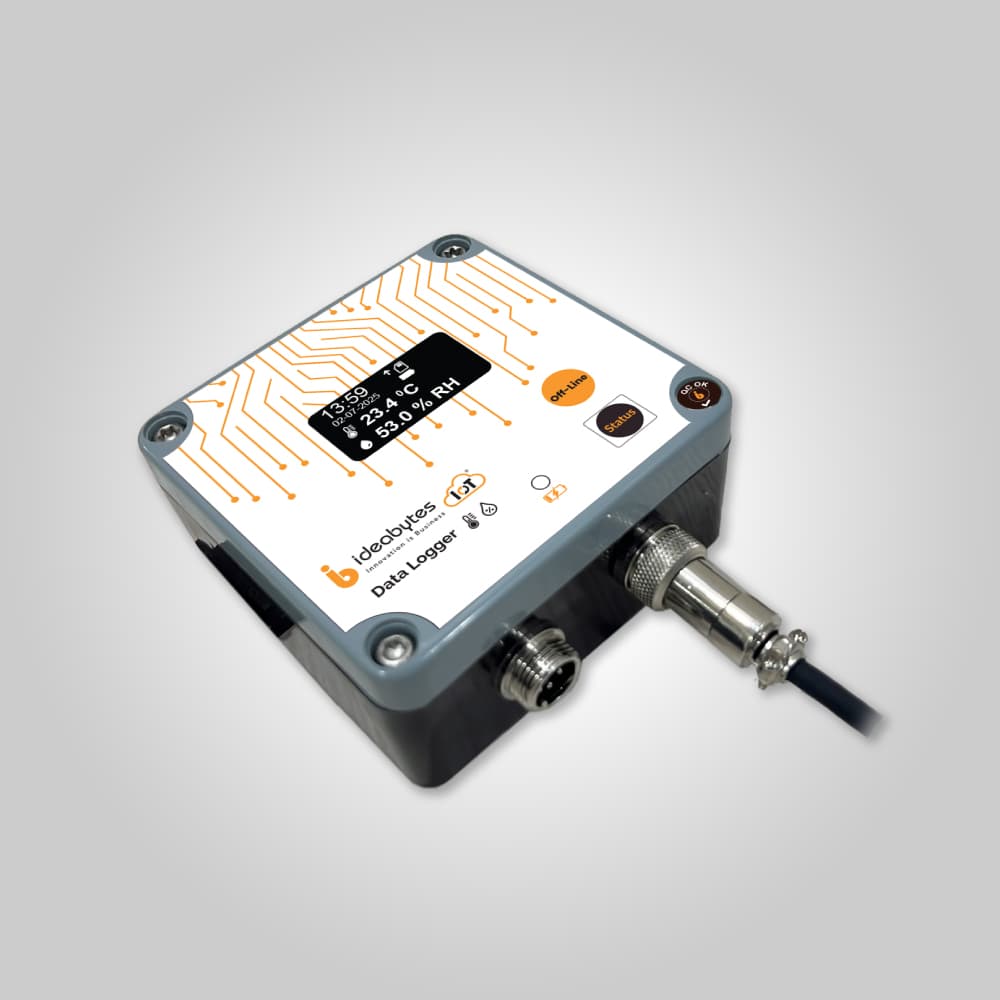
IBI-OTH70 | Offline Temperature & Humidity Data Logger
Measuring Range from -20°C to +70°C
- •±0.5°C accuracy
- •Plug & Play, Wall Mountable Device
- •Data Download Options (Wi-Fi / USB)

IBI-WTR8 | Wi-Fi 8 Channel PT100 Temperature Data Logger (8 Temperature)
Measuring Range PT100: -200°C to 550°C | PT1000: -200°C to 550°C (Optional)
- •Wi-Fi 802.11 b/g/n 2.4 GHz Connectivity
- •0.5°C (0.05% of Full Scale) Accuracy
- •2.4" 128X64 OLED monochrome Graphical Display

IBI-MTR8 | 4G M2M 8 Channel PT100 Temperature Data Logger (8 Temperature)
Measuring Range PT100 : -200°C to 550°C | PT1000 : -200°C to 550°C (Optional)
- •4G LTE CAT1 Technology with In-built M2M SIM Connectivity
- •0.5°C (0.05% of Full Scale) Accuracy
- •2.4" 128X64 OLED monochrome Graphical Display
Other compliance and buyer guides
Frequently asked questions
What is a data logger calibration certificate?
It is a document that records how a data logger compared with a traceable reference standard at defined points, with the measured error, measurement uncertainty, method, date and due date, and the laboratory details. It lets auditors and customers trust that the temperature or humidity data the logger recorded is accurate within a stated tolerance.
How often should a temperature data logger be calibrated?
Annually is the common default, and most SOPs and tenders assume a 12-month interval. Set the interval on risk: shorten it for vaccine, blood and other critical storage, after damage or repair, or if earlier results showed drift. Humidity sensors often need calibration at least every 12 months.
Is Ideabytes a NABL-accredited calibration laboratory?
Ideabytes does not present its own facility as a NABL-accredited laboratory. NABL-traceable calibration certificates for Ideabytes loggers are available on request, and we will confirm the issuing laboratory and its accreditation details before you order so that your QA team can verify them.
What is the difference between NABL-accredited and NABL-traceable certificates?
A NABL-accredited certificate is issued by a laboratory accredited by NABL for that measurement scope and carries its accreditation details. A NABL-traceable certificate means the references used can be traced through accredited calibrations to national standards. Check which your SOP or tender demands and ask your supplier to confirm in writing.
How much does data logger calibration cost?
It depends on the number of loggers and channels, the number of calibration points, whether humidity is included, the temperature range, and whether the work is done on site or in a laboratory. Send us your list of models and required points and we will quote with the certificate type stated.
Will a calibration certificate satisfy NABH or GeM tender requirements?
NABH assessors and GeM or state tenders usually ask for a valid calibration certificate from a traceable, and often NABL-accredited, source, dated within the last 12 months. Check the exact wording in your tender or NABH standard, then ask us for a certificate that matches it when you order.
Related reading
Compliance guides
Glossary
Need audit-ready monitoring?
Tell us what you store, how many points you need to monitor and which audits you face. Our team in Hyderabad will recommend a setup and send a quotation.