
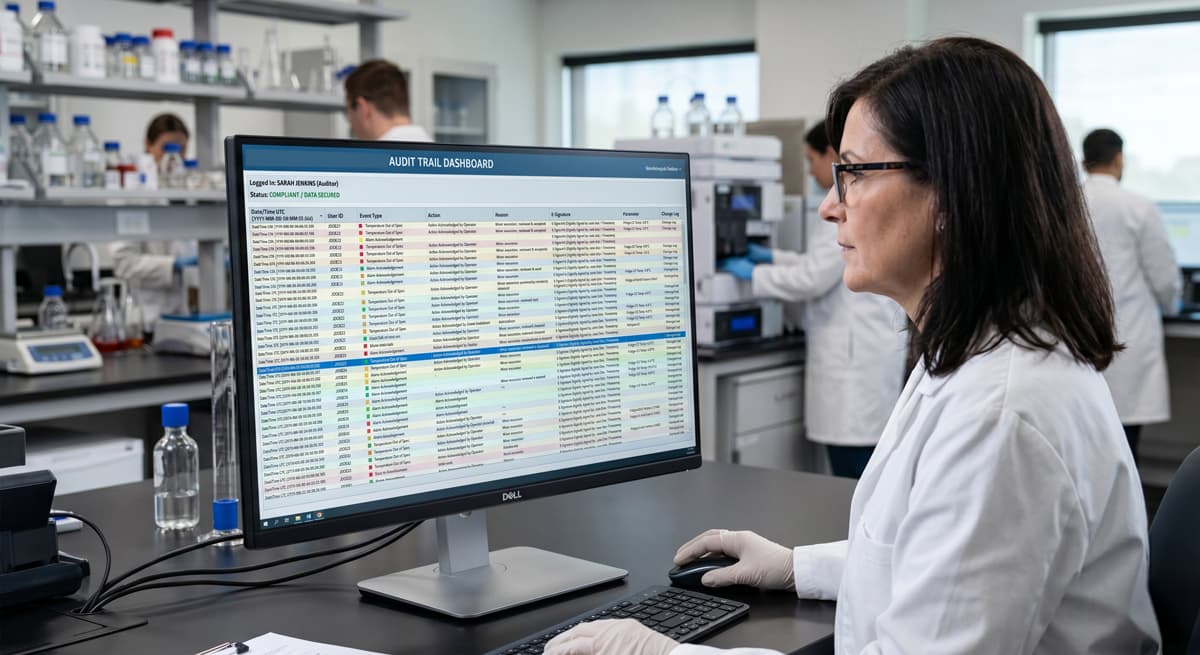
Why 21 CFR Part 11 Audit Trails Decide Pharma Inspections
When an FDA investigator opens a pharmaceutical facility's electronic records, the first thing they typically look for is the 21 CFR Part 11 audit trail. It is the regulatory backbone that tells the agency who measured what, when, and whether anything has been altered since. Industry analysis published in the PDA Journal of Pharmaceutical Science and Technology found that 79% of global drug warning letters issued between 2014 and 2018 cited data integrity. CDER alone issued 21 of 28 such letters between January 2015 and May 2016, a clear signal that audit-trail and electronic-record gaps are the single largest enforcement trigger in modern pharma.
That pressure has not eased. Recent FDA warning letters from 2024 and 2025 repeatedly cite missing audit trails, shared passwords, and the absence of user access levels on the very analytical instrument computers that record release data. For pharmaceutical, biotech, and contract-manufacturing teams, the cost of failure is no longer theoretical: Merck's 2017 IT-integrity incident reportedly cost roughly $105 million to remediate, illustrating how a single data-system failure can dwarf the cost of instrumenting cold-chain assets correctly the first time.
What Part 11 Actually Demands From an Electronic Record
Part 11 is short, but the obligations are precise. Three sub-clauses do most of the heavy lifting:
21 CFR 11.10(e): "Use of secure, computer-generated, time-stamped audit trails to independently record the date and time of operator entries and actions that create, modify, or delete electronic records. Record changes shall not obscure previously recorded information."
11.10(b) — accurate and complete copies of records must be made available to the agency in human-readable and electronic form.
11.10(d) — system access is limited to authorised individuals.
11.10(g) — authority checks ensure only authorised people can use the system, sign records, or alter them.
11.50 — signed records must carry the printed name of the signer, the date and time of signing, and the meaning of the signature (review, approval, authorship).
The FDA's Part 11 Scope and Application guidance further clarifies that audit trails must be incremental, chronological, and non-overwriting, with date and time captured locally to the activity (year-month-day-hour-minute). MHRA's GxP Data Integrity Guidance reinforces the point: audit trails must be enabled by default, users must not be able to disable them, and any administrative action on the trail must itself be logged.
Why Paper and Stand-Alone Chart Recorders Keep Failing Audits
Most warning letters do not stem from malice. They stem from systems that were never engineered to behave the way Part 11 requires. Recent enforcement examples are telling:
MMC Healthcare Ltd. (Sept 2024) — UV-Vis spectrophotometer "lacked an audit trail and defined user access levels."
Amman Pharmaceutical (Feb 2024) — original HPLC source data and metadata overwritten.
Landy International (June 2024) — missing audit-trail functionality; ordered to upgrade and validate.
Unexo Lifesciences (Nov 2024) — shared logins and no audit-trail review.
Shiva Analyticals (July 2025) — audit-trail and user-access deficiencies.
Paper logs and stand-alone chart recorders share the same root cause: a human in the loop who can transcribe late, white out a number, or share a login. The WHO has separately documented that vaccine freezing in the cold chain is "commonplace" when monitoring is poor; the same blind spots that produce regulatory findings also produce real product loss.
How IoT Data Loggers Map to Each Part 11 Sub-Clause
Purpose-built IoT data loggers eliminate the manual layer. The Ideabytes pharma-grade portfolio IBI-MTH120, IBI-CSC50T, and IBI-MTR8 was designed to satisfy the Part 11 control set without operator effort. Each device is shipped with stated FDA 21 CFR Part 11, CE, FCC, IC compliance and is built around an immutable, time-stamped electronic record.
Part 11 Requirement | IoT Capability | Ideabytes Implementation |
|---|---|---|
11.10(d) Authorized access | Role-based access control with named users | IBI-CSC50T cloud platform enforces individual logins and authority checks |
11.10(e) Time-stamped audit trail | Sensor writes value at moment of measurement | IBI-MTH120 4G LTE CAT1 link streams readings continuously to the cloud archive |
11.10(g) Authority checks | E-signature on alarm acknowledgement | IBI-MTR8 events require named operator action before close-out |
11.50 Signed records | Signed PDF reports with name, date and meaning | IBI-CSC50T issues 21 CFR Part 11 compliant PDF, CSV and Excel reports |
IBI-MTH120 Continuous, Cellular, Contemporaneous
The IBI-MTH120 is a 4G M2M Temperature & Humidity Data Logger built on 4G LTE CAT1 technology with an in-built M2M SIM and a stated accuracy of ± 0.5°C between -10°C and +50°C. Because it streams readings over cellular without depending on a local Wi-Fi network, it captures data contemporaneously — the "C" in ALCOA+ — and removes the transcription lag that plagues paper systems. Listed applications include pharmaceutical storage monitoring, healthcare facility compliance, and laboratory and research environments, all of which fall squarely under Part 11 scope.
IBI-CSC50T — Centralised Reporting Without Ripping Out Dixell Controllers
Many pharma sites already run Dixell refrigeration controllers on cold rooms and stability chambers. The IBI-CSC50T Wi-Fi Dixell Interfacing Gateway sits on top of that hardware and turns it into a Part 11-aware system. Its features include the ability to monitor up to 20 parameters per controller and to issue Custom Reports (21CFR Part 11 Compliant) in PDF, CSV and Excel. That single capability solves §11.10(b) accurate and complete copies for agency review and §11.50, since each report can carry the signer's name, timestamp, and meaning.
IBI-MTR8 Eight Probes, One Tamper-Evident Log
For walk-in cold rooms, stability chambers, and ultra-low freezers where multiple measurement points must be evidenced, the IBI-MTR8 4G M2M 8 Channel PT100 Temperature Data Logger records up to eight calibrated PT100 inputs simultaneously with a stated 0.5°C (0.05% of full scale) accuracy, surfaced on a 2.4" 128x64 OLED Monochrome Graphical Display. Each channel writes to the same chronological, non-overwriting audit trail, which means a single device can document an entire stability study without consolidation work at audit time.
ALCOA+ in Practice: From Sensor to Signed Report
The FDA and ISPE both anchor data-integrity expectations in the ALCOA+ framework: Attributable, Legible, Contemporaneous, Original, Accurate, plus Complete, Consistent, Enduring, and Available. Mapped to a pharmaceutical IoT deployment, the picture looks like this:
Attributable — every reading is bound to a unique device ID and to an authenticated user in the IBI-CSC50T platform; no shared logins.
Legible — exported reports stay human-readable for the full retention period in the cloud archive.
Contemporaneous — the IBI-MTH120 and IBI-MTR8 transmit at the moment of measurement, not at the end of a shift.
Original / Accurate — the encrypted log entry on the device is the raw source; calibration is traceable, and the cloud copy carries a tamper-evident hash.
Enduring & Available — redundant on-device buffering plus cloud storage survives connectivity outages, and records can be exported on demand for §11.10(b).
Audit-Day Workflow: What Investigators Actually See
On inspection day, the difference between a paper-based site and an IoT-instrumented site is visible within minutes:
Investigator question: "Show me every excursion in this stability chamber over the last 12 months." A site running IBI-MTR8 sensors exports a signed PDF in seconds; a paper site searches binders.
Investigator question: "Who acknowledged this 2 a.m. high-temperature alarm?" The IBI-CSC50T platform shows the named user, the timestamp, and the meaning of their e-signature.
Investigator question: "Has any reading been deleted?" The chronological, non-overwriting log makes the answer demonstrable rather than asserted.
This is the workflow Part 11 was written to enable. It is also the workflow that prevents the recurring 2024 and 2025 findings missing audit trails, shared passwords, and absent user-access levels from ever appearing on a Form 483.
Beyond Compliance: The ROI of Getting Audit Trails Right
Compliance is the headline, but the operational wins compound. Continuous IoT logging eliminates manual rounds, surfaces refrigeration drift before product is affected, and gives quality teams a defensible record on day one of any inspection. Industry reports indicate that the cost of a single Form 483 audit-trail observation remediation, revalidation, and delayed approvals typically exceeds the cost of instrumenting the affected cold-chain assets by several orders of magnitude.
For pharma, biotech, and CDMO teams modernizing their data-integrity posture, the IBI-MTH120, IBI-CSC50T, and IBI-MTR8 each ship with the certifications regulators expect ISO 9001:2015, ISO/IEC 27001:2022, ISO/IEC 27017:2015 and operate across a -40°C to +85°C environmental envelope, which covers everything from ultra-low freezers to hot-room stability studies.
Closing the Audit-Trail Gap
21 CFR Part 11 has not changed in two decades, but enforcement has sharpened, and the technology to satisfy it has matured. Replacing paper logs and stand-alone recorders with IoT data loggers that produce attributable, contemporaneous, and tamper-evident electronic records turns audit preparation from a fire drill into a routine export. With purpose-built devices like the IBI-MTH120, IBI-CSC50T, and IBI-MTR8, the audit trail becomes a by-product of normal operation, exactly what the regulation intends.