Temperature monitoring
Vaccine Storage & ILR Temperature Monitoring (WHO PQS, UIP)
Vaccine storage in an ILR (ice-lined refrigerator) means holding vaccines at 2–8 °C in a top-opening refrigerator whose lining of ice packs keeps it cold through power cuts, while deep freezers at -15 to -25 °C hold ice packs and some frozen vaccines. ILR temperature monitoring is the continuous record of those two units, with alerts when either leaves range. It is for cold chain officers, district and state immunisation teams, hospitals and private vaccinators. Ideabytes IoT supplies 4G, Wi-Fi and offline temperature loggers with battery backup, live alerts and 21 CFR Part 11 compliant reports that complement the 30-day temperature recorder already in the ILR.
- GeM registered
- 21 CFR Part 11 reports
- Made in India
What goes wrong without monitoring
- A thermometer read twice a day misses the night-time freeze or the afternoon power cut that damages vaccines between readings.
- Freeze-sensitive vaccines such as pentavalent, hepatitis B and IPV lose potency if the ILR bottom drops below 0 °C, often with no visible sign.
- Long power cuts at PHCs and sub-district stores warm the ILR slowly; staff learn about it only after the holdover time has run out.
- The 30-day temperature recorder shows an alarm on its own screen, but nobody outside the cold chain room sees it until the next visit.
- District and state teams cannot see the status of dozens of cold chain points at once, so supervision depends on phone calls.
- Private vaccinators and hospital immunisation clinics often use pharmacy fridges with no independent record at all.
How the system works
- 1Map every ILR, deep freezer and vaccine fridge at the cold chain point, with the range each must hold.
- 2Place a probe in the vaccine basket of each ILR and in each deep freezer; keep the existing 30-day recorder in place.
- 3Use 4G loggers with a built-in SIM where there is no reliable Wi-Fi, and an offline logger where there is no mobile coverage at all.
- 4Set high and low limits and power-failure alerts, and send them to the cold chain handler, the medical officer and the district cold chain officer.
- 5Review daily status on the dashboard, act on every alarm, and file the monthly PDF report with the stock and temperature records.
Standards and regulators
- WHO PQS E006
- UIP guidelines
- eVIN
- CDSCO
- WHO GDP
Recommended loggers for vaccine storage & ilr
Selected from the Ideabytes range for this application. All models report to one cloud dashboard with SMS, email and call alerts.
Showing 8 products

IBI-MT120 | 4G M2M Temperature Data Logger
Measuring Range from -50°C to +120°C
- •4G LTE Cat1/2G fallback Connectivity
- •± 0.5°C (-10°C to +50°C) Accuracy
IBI-MTD120 | 4G M2M Dual Channel Temperature Data Logger
Measuring Range from -50°C to +120°C
- •4G LTE Cat1/2G fallback Connectivity
- •± 0.5°C (-10°C to +80°C) Accuracy
IBI-MT350 | 4G M2M Temperature Data Logger
Measuring Range from -200°C to +350°C
- •4G LTE Cat1/2G fallback Connectivity
- •± 0.5°C (-10°C to +50°C) Accuracy

IBI-WT350 | Wi-Fi Temperature Data Logger
Measuring Range from -200°C to +350°C
- •Wi-Fi 802.11 b/g/n 2.4 GHz Connectivity
- •± 0.5°C (-10°C to +50°C) Accuracy

IBI-MTH70 | 4G M2M Temperature & Humidity Data Logger
Measuring Range from -20°C to +70°C | Humidity from 0% RH to 99% RH (Non - Condensing)
- •4G LTE Cat1/2G fallback
- •± 0.5°C (-10°C to +50°C) Accuracy
IBI-MT70 | 4G M2M GPS Temperature Data Logger
Measuring Range from -30°C to +70°C
- •4G LTE Cat-M1 / GPS Connectivity

IBI-WTH70 | Wi-Fi Temperature & Humidity Data Logger 70
Measuring Range from -20°C to +70°C | Humidity from 0% RH to 99% RH (Non - Condensing)
- •Wi-Fi 802.11 b/g/n 2.4 GHz Connectivity
- •± 0.5°C (-10°C to +50°C) Accuracy
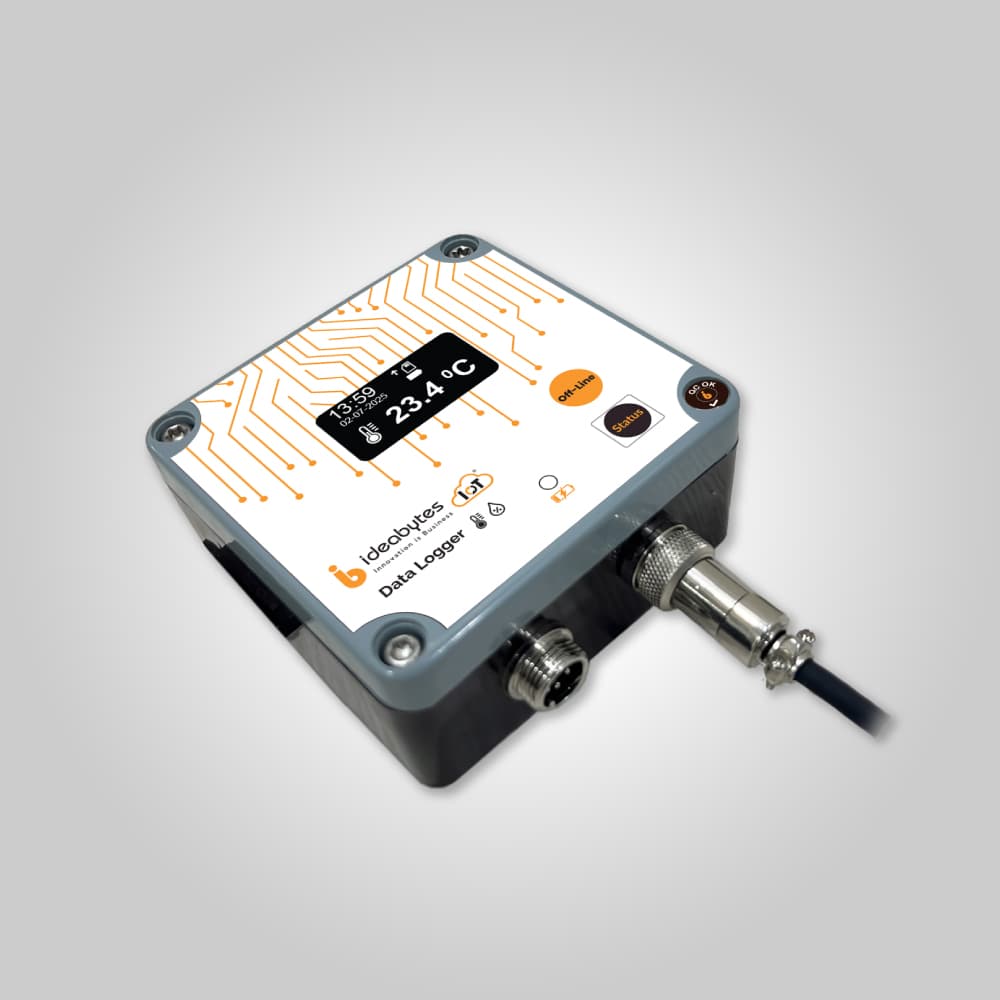
IBI-OT350 | Offline Single Channel Temperature Data Logger
Measuring Range from -200°C to +350°C
- •±0.5°C accuracy
- •Plug & Play, Wall Mountable Device
- •Data Download Options (Wi-Fi / USB)
ILR and deep freezer: the two workhorses of India's vaccine cold chain
Under India's Universal Immunisation Programme (UIP), vaccines move from government medical store depots to state, regional and district vaccine stores and on to PHCs, CHCs and urban health posts. At most of these cold chain points the storage equipment is the same pair: an ice-lined refrigerator that holds vaccines at 2–8 °C, and a deep freezer that runs at -15 to -25 °C to freeze ice packs and store the vaccines that tolerate freezing.
An ILR is built to ride through power cuts. Its ice lining keeps the cabinet cold for many hours without electricity, which is why it is the standard vaccine refrigerator where the grid is unreliable. The same design makes the bottom of the cabinet the coldest spot, and freezing, not heat, is the most common way vaccines are damaged in an ILR. Freeze-sensitive vaccines should never touch the floor or the walls.
For monitoring, that means one probe per unit, placed where the vaccines are, not where it is easiest to fit. In an ILR the probe belongs in the vaccine basket at the level of the freeze-sensitive stock. In a deep freezer it sits among the ice packs. A dual-channel logger such as the IBI-MTD120 covers an ILR and its neighbouring deep freezer with one device and one power point, with separate limits for each.
What a 30 DTR does, and why a continuous remote logger complements it
A 30 DTR (30-day temperature recorder) is a small battery-powered device placed in the ILR or freezer. It records the temperature at short intervals, stores a rolling 30-day history and shows an alarm on its own display when the unit has been too warm or too cold for a set time. It is the minimum record the programme expects at a cold chain point, and it is read and noted by the vaccine handler.
The weakness of a 30 DTR is that it only speaks to the person standing in front of it. A continuous remote logger sends the same kind of reading to a cloud dashboard every 15 minutes by default, raises a live alert, app notification or optional SMS the moment a limit is crossed, and keeps a complete history beyond 30 days. The recorder stays in the ILR as the local reference; the remote logger makes sure somebody acts before the vaccines are lost.
WHO PQS E006 device expectations
WHO's Performance, Quality and Safety (PQS) system groups temperature monitoring devices under category E006, which covers 30-day recorders, remote temperature monitoring devices and related equipment. The specifications cover measurement accuracy, alarm behaviour, data retention, battery life and robustness. UNICEF and many national programmes buy against these specifications.
Ideabytes loggers are designed with those expectations in mind: ±0.5 °C accuracy between -10 °C and +50 °C, 0.1 °C resolution, configurable intervals, alarm logs and an audit trail. Ask us for the documentation of the specific model you are considering; our compliance page explains what WHO PQS listing does and does not mean for a buyer.
Power-cut alerts: 4G loggers with battery backup
At a PHC the most dangerous event is a long power cut that nobody reports. Ideabytes 4G loggers carry a built-in M2M SIM and an internal lithium-ion battery that keeps them running for up to 20 hours after mains power fails (up to 30 hours on the IBI-MT70). They keep reading the ILR and send a power-failure alert, so the medical officer knows to arrange a generator or move vaccines while the ice lining still holds.
- IBI-MT120 and IBI-MTD120: -50 °C to +120 °C, single or dual channel, for an ILR and its deep freezer.
- IBI-MT350 and IBI-WT350: PT100 probe, -200 °C to +350 °C, for deep freezers and ultra-low storage.
- IBI-MTH70 and IBI-WTH70: temperature and humidity for the vaccine store room itself.
- IBI-OT350: offline logger with 90 days of internal storage for points with no network coverage.
eVIN and state programme dashboards
India runs eVIN (Electronic Vaccine Intelligence Network) as the national system for vaccine stock and cold chain temperature visibility across UIP cold chain points. Ideabytes loggers are not part of eVIN and we do not claim integration with it. Programme teams and hospitals use our loggers where they need an independent, alarm-driven record: in hospital immunisation clinics, in private facilities outside eVIN, in state or city pilots, or as an additional layer at high-value stores.
Private vaccinators, hospitals and GeM buying
Private hospitals, paediatric clinics and travel vaccination centres usually store vaccines in a purpose-built pharmacy refrigerator rather than an ILR, but the monitoring need is identical: a continuous 2–8 °C record, alerts to the person in charge and a report the auditor can read. A Wi-Fi logger suits a single clinic; a 4G logger suits a chain with branches across a city.
Government buyers can purchase through GeM, where Ideabytes IoT is registered, or through a tender. For a tender, share the technical specification and we will respond with a compliance statement, datasheets and NABL-traceable calibration certificates. Cost depends on the number of cold chain points, the mix of ILRs and freezers, connectivity and the reporting subscription.
Compliance guides
Frequently asked questions
What temperature should vaccines be stored at in an ILR?
Vaccines in an ice-lined refrigerator are kept at +2 °C to +8 °C. Freeze-sensitive vaccines should be kept in the basket, away from the floor and walls, because the bottom of an ILR is the coldest part. Deep freezers used alongside the ILR run at -15 °C to -25 °C for ice packs. A probe in the vaccine basket shows what the vaccines actually experience.
What is a 30 DTR and do I still need it with a remote logger?
A 30 DTR is a 30-day temperature recorder kept inside the ILR or freezer; it stores a rolling month of readings and shows alarms on its display. Keep it, as the programme expects it. A remote logger complements it by sending readings to the cloud and alerting staff by app or SMS immediately, so an excursion is handled before the next manual check.
Will the logger keep working during a power cut?
Yes. Ideabytes 4G and Wi-Fi loggers have an internal lithium-ion battery with up to 20 hours of backup (up to 30 hours on the IBI-MT70), and they send a power-failure alert. The 4G units carry their own SIM, so they report even when the facility router is off. Readings are also stored internally, so nothing is lost if the network drops.
Are Ideabytes loggers WHO PQS prequalified?
Our loggers are designed with WHO PQS E006 expectations for accuracy, alarms and data retention in mind. Prequalification applies to a specific model, so ask us for the current documentation of the model you plan to buy before writing it into a tender. Our WHO PQS page explains what a PQS listing covers.
Can government health departments buy these loggers on GeM?
Yes. Ideabytes IoT is registered on GeM, so state health societies, district hospitals and medical colleges can procure through the GeM portal. The loggers are made in India, the HSN code appears on each product page and invoice, and NABL-traceable calibration certificates are available on request for tender documentation.
How much does vaccine cold chain monitoring cost per cold chain point?
It depends on how many ILRs, freezers and fridges each point has, whether you need 4G, Wi-Fi or offline loggers, single or dual channel units, and the reporting subscription. Programme-scale deployments are quoted differently from a single clinic. Send us the equipment list and we will prepare an itemised quote.
Related reading
From the blog
Plan monitoring for your site
Tell us what you store, how many points you need to monitor and which audits you face. Our team in Hyderabad will recommend a setup and send a quotation.