Temperature monitoring
Hospital & Pharmacy Fridge and Freezer Temperature Monitoring
Fridge temperature monitoring in a hospital or pharmacy is the continuous, automatic recording of the temperature inside medicine refrigerators (2–8 °C) and freezers (typically -20 °C), with alerts when a unit drifts out of range and a tamper-proof record for inspectors. It replaces the twice-daily paper log that misses night-time and weekend excursions. It is for hospital pharmacists, biomedical engineers, nursing superintendents and quality teams preparing for NABH or JCI assessment. Ideabytes IoT supplies Wi-Fi, 4G and Bluetooth temperature and temperature-humidity loggers, single and dual channel, with SMS and app alerts and 21 CFR Part 11 compliant PDF reports.
- GeM registered
- 21 CFR Part 11 reports
- Made in India
What goes wrong without monitoring
- Paper temperature logs are filled twice a day, so an excursion at 2 am or over a long weekend is discovered only when the next shift opens the fridge.
- Domestic-style refrigerators used on wards cycle widely and freeze the back shelf, damaging insulin, vaccines and biologicals without anyone noticing.
- Power cuts and generator changeover delays warm a fridge silently; nobody knows how long the stock was above 8 °C.
- Handwritten logs are easy to back-fill and hard to defend when an assessor asks for the excursion history of a specific unit.
- Pharmacy, ward and OT fridges are spread across floors and buildings, so one person cannot physically check every unit on time.
- Hospital IT teams are often reluctant to put new devices on the clinical network, which stalls Wi-Fi projects for months.
How the system works
- 1List every medicine fridge, freezer, OT, ICU and store room, and note the range each must hold (2–8 °C, -20 °C, room temperature and humidity).
- 2Fit one logger per unit, or a dual-channel logger where a fridge and its freezer sit side by side; place the probe in the product zone, not by the door.
- 3Choose connectivity per site: Wi-Fi or Bluetooth where the network is available, 4G with a built-in SIM where you want no dependency on hospital IT.
- 4Set limits and an escalation chain so an alert reaches the pharmacist first, then biomedical engineering, then the duty manager if nobody acknowledges.
- 5Review daily dashboards and scheduled PDF reports, record the cause and corrective action for every excursion, and keep calibration certificates on file.
Standards and regulators
- NABH
- JCI
- Schedule M
- WHO GDP
- 21 CFR Part 11
Recommended loggers for hospital & pharmacy
Selected from the Ideabytes range for this application. All models report to one cloud dashboard with SMS, email and call alerts.
Showing 8 products

IBI-WTH120 | Wi-Fi Temperature & Humidity Data Logger
Measuring Range from -40°C to +120°C | Humidity from 0% RH to 100% RH (Condensing)
- •Wi-Fi 802.11 b/g/n 2.4 GHz Connectivity
- •± 0.5°C (-10°C to +50°C) Accuracy
 Popular
IBI-MTH120 | 4G M2M Temperature & Humidity Data Logger
Measuring Range from -40°C to +120°C
- •4G LTE CAT1 Technology with In-built M2M SIM Connectivity
- •± 0.5°C (-10°C to +50°C) Accuracy

IBI-WTD120 | Wi-Fi Dual Channel Temperature Data Logger
Measuring Range from -50°C to +120°C
- •Wi-Fi 802.11 b/g/n 2.4 GHz Connectivity
- •± 0.5°C (-10°C to +50°C) Accuracy

IBI-MTD120 | 4G M2M Dual Channel Temperature Data Logger
Measuring Range from -50°C to +120°C
- •4G LTE Cat1/2G fallback Connectivity
- •± 0.5°C (-10°C to +80°C) Accuracy
M2M Customized Room Parameter Data Logging & Live Alerting System
4G M2M Customized Data Logger - Sensor & Accessories need to be procure separately
- •4G LTE CAT1 Technology with In-built M2M SIM
PopularIBI-WT120 | Wi-Fi Temperature Data Logger
Measuring Range from -50°C to +120°C
- •Wi-Fi 802.11 b/g/n 2.4 GHz Connectivity
- •± 0.5°C (-10°C to +50°C) Accuracy
IBI-MT120 | 4G M2M Temperature Data Logger
Measuring Range from -50°C to +120°C
- •4G LTE Cat1/2G fallback Connectivity
- •± 0.5°C (-10°C to +50°C) Accuracy
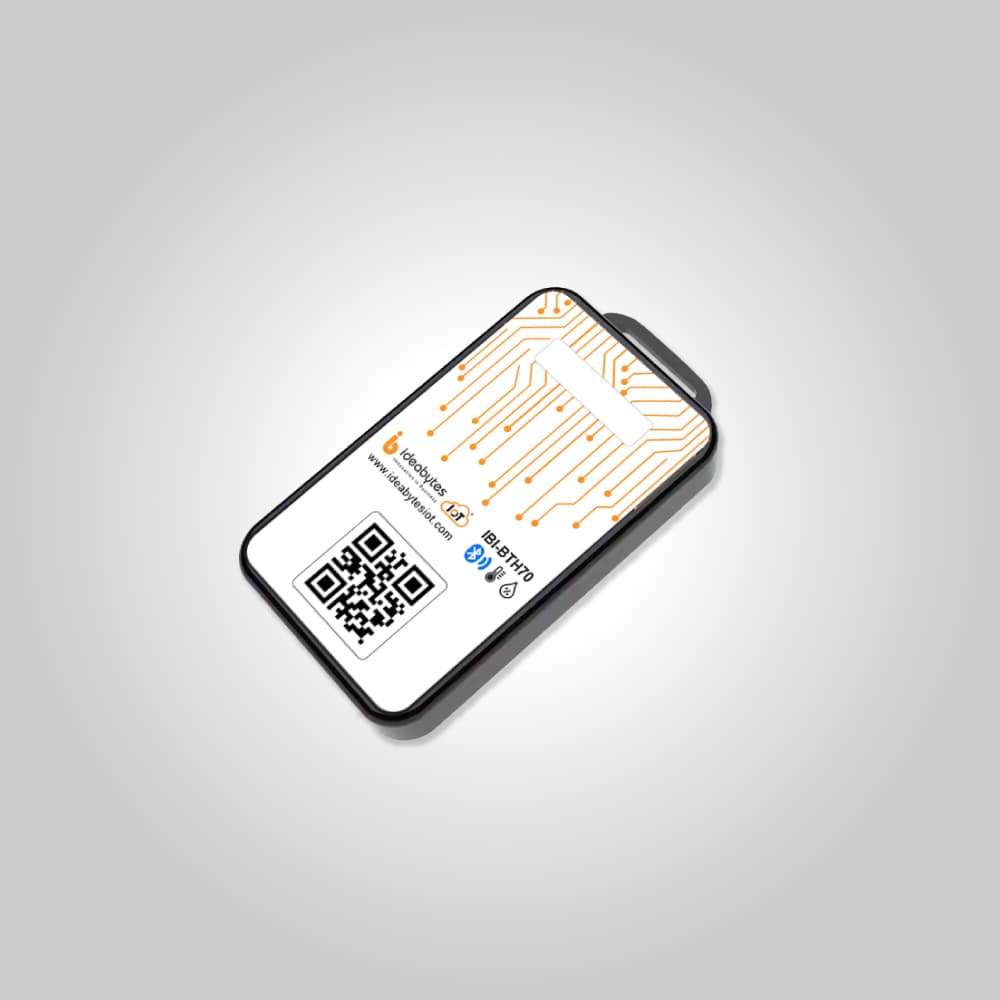
IBI-BTH70 | Bluetooth Temperature & Humidity Data Logger
Measuring Range from -20°C to +70°C | Humidity from 5% RH to 95% RH
- •Highly accurate built-in temperature & humidity sensor
- •It can store 32000 packets of temperature and humidity data
Fridge and freezer temperature monitoring: 2–8 °C and -20 °C
Most hospital medicines that need refrigeration are labelled 2–8 °C: insulin, vaccines, many biologicals, eye drops, oxytocin and a long list of injectables. A few products, such as some plasma-derived items and reagents, are stored frozen at around -20 °C. The monitoring question is the same for both: what was the temperature at the product, every few minutes, all day and all night, and did anyone act when it went wrong?
Ideabytes loggers with an external probe cover both ranges comfortably. The 120-series units read -50 °C to +120 °C (temperature and humidity models -40 °C to +120 °C) at ±0.5 °C accuracy between -10 °C and +50 °C, with 0.1 °C resolution. Readings are sent every 15 minutes by default, and the interval is configurable if your SOP asks for more frequent readings.
Dual-channel loggers for fridge and freezer pairs
Pharmacies often run a medicine fridge and a small freezer next to each other, or a combined fridge-freezer. A dual-channel logger such as the IBI-WTD120 (Wi-Fi) or IBI-MTD120 (4G) takes two independent probes, one for each compartment, so you monitor two storage zones with one device, one power point and one line on the dashboard. Each channel has its own limits and its own alerts.
For rooms where humidity matters as much as temperature, pick a temperature-and-humidity model instead. The IBI-WTH120 and IBI-MTH120 read 0–100% RH at ±2% RH alongside temperature, which suits medicine store rooms, OTs and ICUs.
Why the paper medical refrigerator temperature log is not enough
A paper medical refrigerator temperature log shows two readings a day at best. It cannot show the four hours the fridge spent at 12 °C after a door was left ajar, and it cannot prove that a reading was not written in later. A continuous logger records every interval, timestamps every change to settings and limits in an audit trail, and produces an alarm log that shows when each alert was raised and acknowledged.
Many hospitals keep the paper log for a transition period and let the automatic record become the primary one once staff trust it. The PDF reports include min/max, mean kinetic temperature (MKT) and trend graphs, which is what a pharmacist needs when deciding whether stock that went out of range can still be used.
What NABH and JCI assessors typically look for
NABH and JCI standards expect hospitals to store medicines under the conditions the manufacturer specifies and to be able to show it. In practice assessors typically ask to see the temperature record for a sample of fridges, what happened during the last excursion, who was informed, and what corrective action was taken. They also check that the measuring device is calibrated. Hospital pharmacies that stock Schedule H drugs are also expected to follow the storage conditions set out under the Drugs and Cosmetics Rules, and WHO good distribution practice is a useful reference for storage SOPs.
Ideabytes is not an accreditation body, and a logger alone does not make a hospital compliant. What it gives your quality team is a complete, time-stamped, 21 CFR Part 11 compliant record, with CAPA notes against each alarm, and NABL-traceable calibration certificates on request.
Alerts to pharmacy and biomedical staff
An alert is only useful if the right person sees it quickly. Each Ideabytes logger can raise live alerts and app push notifications, with SMS as an option, when a channel crosses its limit or the device loses power or network. Set a short delay so a door opened for stock-taking does not trigger an alarm, then build an escalation chain: pharmacist on duty first, biomedical engineering next, duty manager last.
- Separate limits per channel, such as 2–8 °C for the fridge and -25 to -15 °C for the freezer.
- Power-failure and offline alerts, with up to 20 hours of internal battery backup on the mains-powered Wi-Fi and 4G units.
- Up to 90 days of internal storage at 15-minute sampling, so a network outage does not leave gaps in the record.
OT, ICU and store-room temperature and humidity monitoring
Operating theatres, ICUs, CSSD and pharmacy store rooms need room temperature and relative humidity kept within the limits in your infection-control and pharmacy SOPs. Humidity that climbs during the monsoon affects sterile packs and some dosage forms, and it is rarely logged at all. A wall-mounted temperature-humidity logger per room gives the facilities team the same dashboard, alerts and reports as the fridges.
For a building with many rooms and a mix of sensors, the IBI-MC-X customised 4G data logger can collect several room parameters in one system; its sensors and accessories are specified and supplied per project.
Small clinics vs hospital chains: Wi-Fi, Bluetooth or 4G
A single clinic or retail pharmacy with one or two fridges usually starts with a Wi-Fi logger such as the IBI-WT120, or a Bluetooth IBI-BTH70 read from a phone app. They are quick to install and need no SIM.
Multi-site hospital chains usually prefer 4G loggers (IBI-MT120, MTH120, MTD120) with a built-in M2M SIM. They connect from the first power-on, need no Wi-Fi credentials or firewall changes from hospital IT, and report to one cloud dashboard across every branch. Cost depends mainly on the number of monitoring points, the connectivity you choose and the reporting subscription, which is why we quote per site after a short survey.
Compliance guides
Frequently asked questions
What temperature should a pharmacy medicine fridge be kept at?
Most refrigerated medicines are labelled 2–8 °C, and the fridge should be set to hold the middle of that band, around 5 °C, so small swings stay in range. Always follow the label of the product you store. Freezers for frozen products are usually monitored around -20 °C. A logger with its probe in the product zone shows what the medicines actually experience, not what the fridge display says.
Can one logger monitor both a fridge and a freezer?
Yes. A dual-channel logger such as the IBI-WTD120 (Wi-Fi) or IBI-MTD120 (4G) takes two external probes, one in each compartment, with separate limits and alerts per channel. Both channels read -50 °C to +120 °C, which covers a 2–8 °C fridge and a -20 °C freezer. It saves a device and a power point for every fridge-freezer pair.
Do we need Wi-Fi from the hospital IT team?
Not if you choose 4G. The IBI-MT120, MTH120 and MTD120 have a built-in M2M SIM and send data over 4G LTE with 2G fallback, so they need no hospital network, credentials or firewall changes. Wi-Fi and Bluetooth models suit sites where the network is available and IT approval is easy. Both types use the same dashboard and reports.
Will the records satisfy an NABH assessor?
NABH expects medicines to be stored as the manufacturer specifies and for the hospital to show evidence. Ideabytes loggers give you a continuous, time-stamped record, an audit trail, alarm logs with corrective action notes and 21 CFR Part 11 compliant PDF reports. The assessment outcome depends on your whole medication management process, not the logger alone.
Are calibration certificates available, and are the loggers on GeM?
Yes. NABL-traceable calibration certificates are available on request with each logger, which is what assessors usually ask to see. Ideabytes IoT is registered on GeM, so government hospitals and medical colleges can buy through the GeM portal. Loggers are manufactured in India and the HSN code is printed on each product page.
How much does a hospital fridge temperature monitoring system cost?
It depends on the number of fridges, freezers and rooms, the connectivity (Wi-Fi, Bluetooth or 4G), single or dual channel units and the reporting subscription. A small clinic and a 500-bed hospital need very different setups. Share your list of units with us and we will send an itemised quote for your site.
Related reading
Applications
From the blog
Plan monitoring for your site
Tell us what you store, how many points you need to monitor and which audits you face. Our team in Hyderabad will recommend a setup and send a quotation.