Temperature monitoring
Bulk Milk Cooler & Milk Chilling Centre Monitoring
A bulk milk cooler (BMC) is an insulated stainless steel tank with its own refrigeration unit that chills raw milk at the village collection point, typically holding 500 to 5,000 litres, before a tanker takes it to the dairy. Ideabytes IoT does not make or sell BMCs. This page is about monitoring them: milk temperature, compressor and agitator status read over MODBUS where the BMC controller exposes it, and power cuts, with alerts and records for the society, the route supervisor and the dairy union. It is for dairy cooperatives, private dairies and BMC operators, using 4G loggers and gateways that work without Wi-Fi.
- GeM registered
- 21 CFR Part 11 reports
- Made in India
What goes wrong without monitoring
- A power cut at night stops the compressor, and the society finds warm milk only when the morning collection starts.
- Milk is not brought down to 4 °C fast enough after a big evening collection, and bacterial counts rise before the tanker arrives.
- A compressor, thermostat or agitator fault goes unnoticed because nobody is at the chilling centre between collections.
- The dairy or union rejects or downgrades a load and the society has no temperature record to show what happened.
- Hand-written chilling registers are filled in after the fact, and cannot show how long the milk sat above the target.
- Village chilling centres rarely have Wi-Fi or reliable broadband, so office-style monitoring systems simply do not connect.
How the system works
- 1Survey each BMC or chiller: tank size, controller make and whether the controller has an RS485 MODBUS port.
- 2Where it does, connect a CSC50RM 4G gateway to read the controller registers; where it does not, fit an MT120 logger with its -50 °C to +120 °C probe in the milk tank or its thermowell.
- 3Set limits and alarm delays per collection shift, so a normal warm-milk intake does not trigger false alarms but a slow chill does.
- 4Send SMS, app and email alerts to the society secretary, the BMC operator and the dairy route supervisor, with escalation if nobody responds.
- 5Share scheduled daily reports with the dairy or union, and hand the chilling record over with each tanker pickup.
Standards and regulators
- FSSAI
- NDDB guidance for dairy cooperatives
- 21 CFR Part 11
Recommended loggers for bulk milk coolers
Selected from the Ideabytes range for this application. All models report to one cloud dashboard with SMS, email and call alerts.
Showing 8 products

IBI-MT120 | 4G M2M Temperature Data Logger
Measuring Range from -50°C to +120°C
- •4G LTE Cat1/2G fallback Connectivity
- •± 0.5°C (-10°C to +50°C) Accuracy
IBI-MT350 | 4G M2M Temperature Data Logger
Measuring Range from -200°C to +350°C
- •4G LTE Cat1/2G fallback Connectivity
- •± 0.5°C (-10°C to +50°C) Accuracy

IBI-CSC50RM | 4G RS485 MODBUS Interfacing Gateway
8 Default Parameters (Configuration Charges additional)
- •Can Communicate up to 15 RS-485 MODBUS RTU enabled Devices
- •Maximum of 30 parameters can be monitored based on requirement (Single or Multiple RS485 Devices)
IBI-CSC50R | Wi-Fi RS485 MODBUS Interfacing Gateway
8 Default Parameters (Configuration Charges additional)
- •Can Communicate up to 15 RS-485 MODBUS RTU enabled Devices
- •Maximum of 30 parameters can be monitored based on requirement (Single or Multiple RS485 Devices)
 Popular
IBI-WT120 | Wi-Fi Temperature Data Logger
Measuring Range from -50°C to +120°C
- •Wi-Fi 802.11 b/g/n 2.4 GHz Connectivity
- •± 0.5°C (-10°C to +50°C) Accuracy
IBI-MTD120 | 4G M2M Dual Channel Temperature Data Logger
Measuring Range from -50°C to +120°C
- •4G LTE Cat1/2G fallback Connectivity
- •± 0.5°C (-10°C to +80°C) Accuracy
 Popular
IBI-MTH120 | 4G M2M Temperature & Humidity Data Logger
Measuring Range from -40°C to +120°C
- •4G LTE CAT1 Technology with In-built M2M SIM Connectivity
- •± 0.5°C (-10°C to +50°C) Accuracy
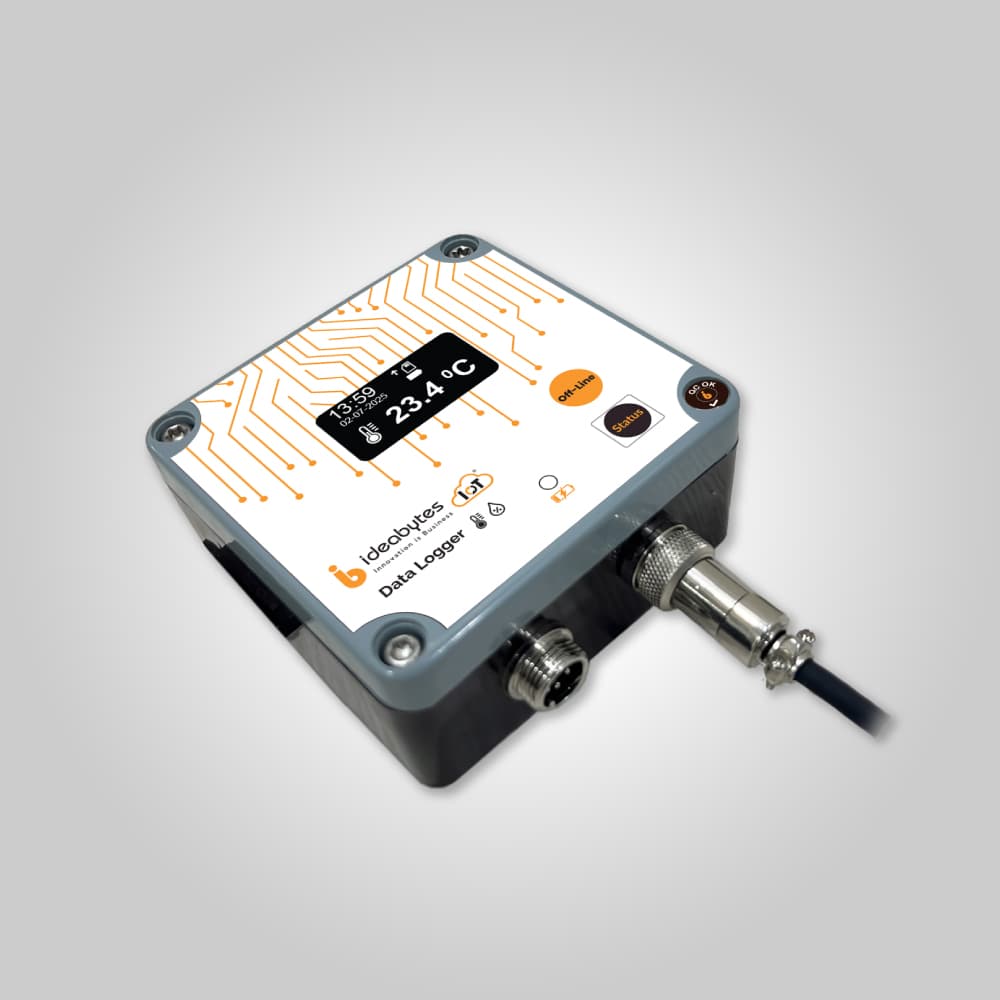
IBI-OT120 | Offline Single Channel Temperature Data Logger
Measuring Range from -50°C to +120°C
- •±0.5°C accuracy
- •Plug & Play, Wall Mountable Device
- •Data Download Options (Wi-Fi / USB)
What a bulk milk cooler does and the temperature it must reach
Raw milk leaves the animal at around 35 °C, the temperature at which bacteria multiply fastest. A bulk milk cooler or milk chiller removes that heat quickly and holds the milk cold until collection. Dairy practice and FSSAI guidance for raw milk point to chilling to 4 °C or below as soon as possible after milking, and BMC specifications commonly ask for the tank to reach that temperature within a few hours of each collection. Treat those figures as guidance and follow the norm set by your dairy or union.
Typical BMCs at village dairy cooperative societies hold 500 to 5,000 litres. Larger milk chilling centres and milk chiller plants use plate heat exchangers and chilled-water systems, and handle milk from many societies before it goes to the processing plant.
Most village BMCs use direct expansion, where the refrigerant evaporates in a jacket around the tank, and an agitator keeps the milk moving so it cools evenly. Some milk chillers use an ice bank or chilled water instead, which can keep cooling for a while after a power cut. Either way, the milk temperature over time after each collection is the number that decides quality.
Why milk chilling centres lose milk
Most losses come from a handful of causes. Grid power in rural areas is interrupted for hours, and a diesel generator may not start or may not be switched on. Evening collections are larger than the cooler was sized for, so the milk takes too long to chill. A compressor trips, a thermostat drifts, or the agitator stops and the milk at the top of the tank stays warm while the controller shows a normal reading near the evaporator.
Because the chilling centre is often unattended between collections, these faults are found hours later. By then the load may fail the dairy platform tests, and without a record nobody can tell whether the problem was at the BMC, on the tanker or at the plant.
Bulk milk cooler temperature monitoring: probe logger or MODBUS gateway
The simplest option is an independent probe logger. The IBI-MT120 is a 4G M2M temperature logger with a -50 °C to +120 °C probe, ±0.5 °C accuracy between -10 °C and +50 °C, a built-in M2M SIM and an internal 4,400 mAh battery that keeps it recording for up to 20 hours during a power failure. It stores 90 days of readings at 15-minute sampling. Because it measures the milk independently of the cooler controller, it also catches a controller or thermostat fault. Where a centre has Wi-Fi, the IBI-WT120 does the same job over Wi-Fi, and where only a record is needed, the offline IBI-OT120 stores 90 days of readings for download over Wi-Fi or USB.
Where the BMC controller exposes MODBUS registers over RS485, the IBI-CSC50RM 4G gateway (or the Wi-Fi IBI-CSC50R) can read it directly. Each gateway communicates with up to 15 MODBUS RTU devices and monitors up to 30 parameters, so milk temperature, set point, compressor run status and alarm codes can be logged alongside each other, subject to what the controller actually provides.
Alerts for power cuts, compressor faults and slow chilling
An alarm is only useful if it reaches someone who can act. Set alerts so that the society secretary and BMC operator are told first, and the dairy route supervisor is told if the milk stays above the limit. Loggers send SMS, app push notifications and email, and every alarm is written to the alarm log with the time it was acknowledged and the corrective action taken.
- High milk temperature after the allowed chilling time.
- Loss of mains power at the chilling centre, while the logger runs on its battery.
- Compressor or agitator stopped, where read from the controller over MODBUS.
- Device offline, so a missing signal is never mistaken for a normal reading.
Milk chilling centre temperature records for the dairy and union
Every reading is time-stamped and kept with an audit trail. Reports come as 21 CFR Part 11 compliant PDFs with trend graphs, minimum and maximum values, alarm logs and mean kinetic temperature, on demand or scheduled daily, weekly or monthly. A union can see all its chilling centres on one dashboard and compare how quickly each BMC chills milk after collection.
These records support the FSSAI requirement to keep raw milk chilled and give cooperatives and private dairies the evidence they need when a load is questioned. NABL-traceable calibration certificates are available on request.
Why 4G suits village chilling centres
Most bulk milk coolers sit in village society buildings with no Wi-Fi. The IBI-MT120 and IBI-CSC50RM carry a built-in M2M SIM and connect over 4G LTE Cat1, so there is no router or broadband line to install and maintain. Ideabytes IoT is a DOT-approved M2M service provider and manufactures its loggers in India. If coverage drops, readings are stored in the device and uploaded when the network returns, so the record has no gaps.
From BMC to tanker: the handover
The BMC record ends when the milk is pumped into the insulated tanker. Handing the chilling report over with the load, and monitoring the tanker itself, gives the dairy an unbroken record from the village to the plant. For tanker and truck monitoring with GPS, see our in-transit cold chain and refrigerated truck pages. A dual-channel logger such as the IBI-MTD120 can watch two tanks from one device, and the IBI-MTH120 can log room temperature and humidity in the milk testing room. Where a centre also runs hot water for cleaning, the PT100-based IBI-MT350, reading -200 °C to +350 °C, covers that range too.
Compliance guides
Frequently asked questions
Does Ideabytes sell bulk milk coolers?
No. Ideabytes IoT makes temperature data loggers and IoT gateways, not bulk milk coolers or milk chiller plants. We add monitoring to the coolers you already have, from any manufacturer, using an independent probe logger or a MODBUS gateway that reads the cooler controller where it exposes MODBUS registers.
What temperature should milk in a bulk milk cooler be?
As general guidance, raw milk should be chilled to 4 °C or below as quickly as possible after collection and held there until the tanker arrives. Your dairy or union may set a specific time and temperature norm for its chilling centres, and the logger limits and alarm delays should be set to match that norm.
Can the gateway read my BMC controller?
Only if the controller has an RS485 port and exposes readings as MODBUS RTU registers. Many modern cooler controllers do, but not all. Share the controller make and model and we will confirm which parameters can be read. If it cannot be read, an independent MT120 probe logger still gives you the milk temperature and power-cut alerts.
What happens during a power cut at the chilling centre?
The IBI-MT120 keeps recording and sending alerts on its internal battery for up to 20 hours, and stores 90 days of readings at 15-minute sampling. The society secretary and route supervisor are alerted that milk temperature is rising, so they can start the generator or arrange an early pickup.
Is this suitable for dairy cooperatives in India?
Yes. The loggers and gateways are manufactured in India, use a built-in 4G M2M SIM that works in villages without Wi-Fi, and produce the temperature records that support FSSAI requirements for raw milk. Ideabytes IoT is registered on GeM for government and cooperative buyers, and NABL-traceable calibration certificates are available on request.
How much does bulk milk cooler monitoring cost?
It depends on the number of coolers, whether you use a probe logger or a MODBUS gateway, whether you need 4G or Wi-Fi, and the reporting and SMS plan. Share the number of chilling centres and the cooler controller models and we will send an itemised quote.
Related reading
Plan monitoring for your site
Tell us what you store, how many points you need to monitor and which audits you face. Our team in Hyderabad will recommend a setup and send a quotation.