
Temperature & Humidity Data Logger
IBI-WTH50 – Wi-Fi Temperature & Humidity Data Logger (Built-in Sensor)
Wi-Fi Temperature & Humidity Data Logger (Built-in Sensor)
- Wi-Fi 802.11 b/g/n 2.4 GHz Connectivity
- Accuracy: ±0.5°C (−10°C to +50°C)

A clean room monitor records the environmental conditions a classified area must hold, raises an alarm when a value drifts and keeps a record a GMP inspector can review. Ideabytes IoT supplies the temperature, humidity and CO₂ part of that picture: wall-mounted temperature and humidity loggers with built-in sensors, probe loggers for chambers and pass-throughs, RS485 MODBUS temperature-humidity and CO₂ sensors with Wi-Fi or 4G gateways for multi-room suites, and multi-channel PT100 loggers for process equipment, all reporting to one cloud dashboard with alerts and 21 CFR Part 11 compliant reports. We do not supply differential pressure sensors or particle counters; those come from your HVAC and validation partners and sit alongside this system.
Showing 10 products
Wi-Fi Temperature & Humidity Data Logger (Built-in Sensor)
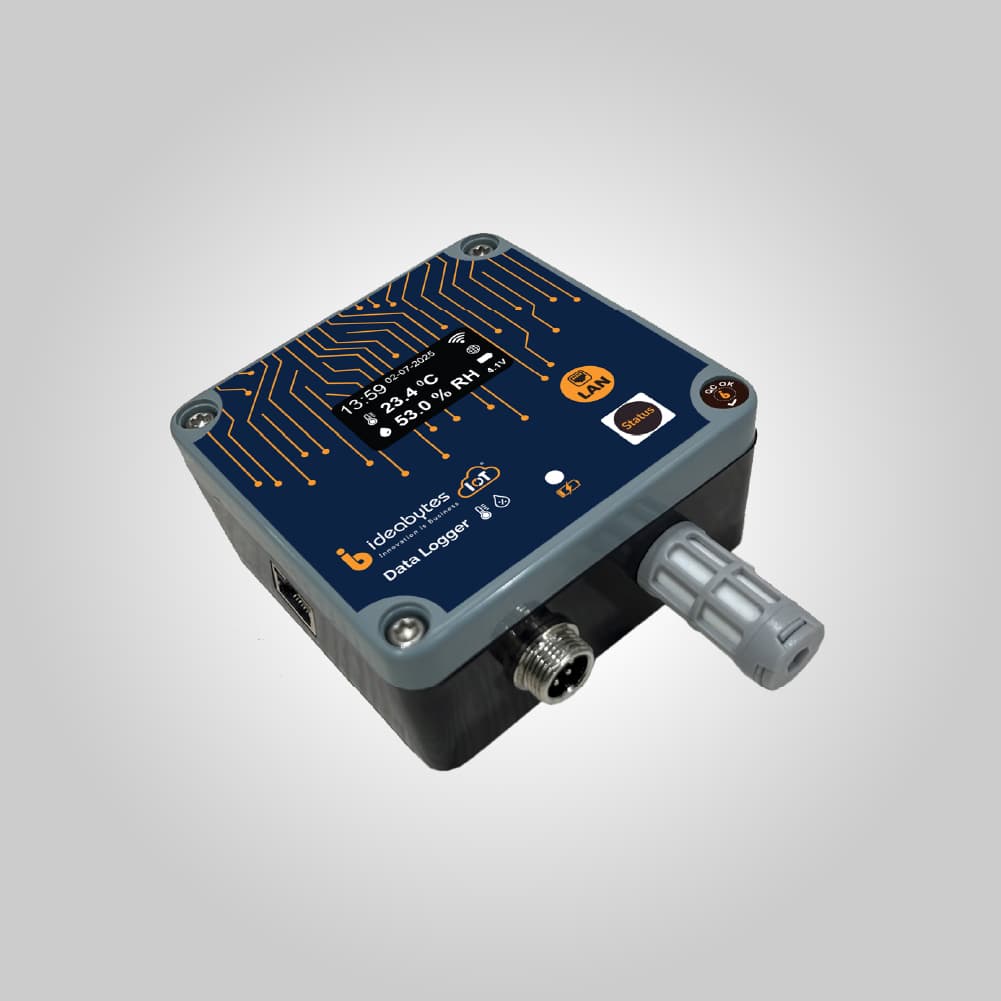
Ethernet Temperature & Humidity Data Logger (Built-in Sensor)

4G M2M Temperature & Humidity Data Logger (Built-in Sensor)

RS-485 Modbus Temperature and Humidity Sensor

CO2 Sensor (RS-485 Modbus)
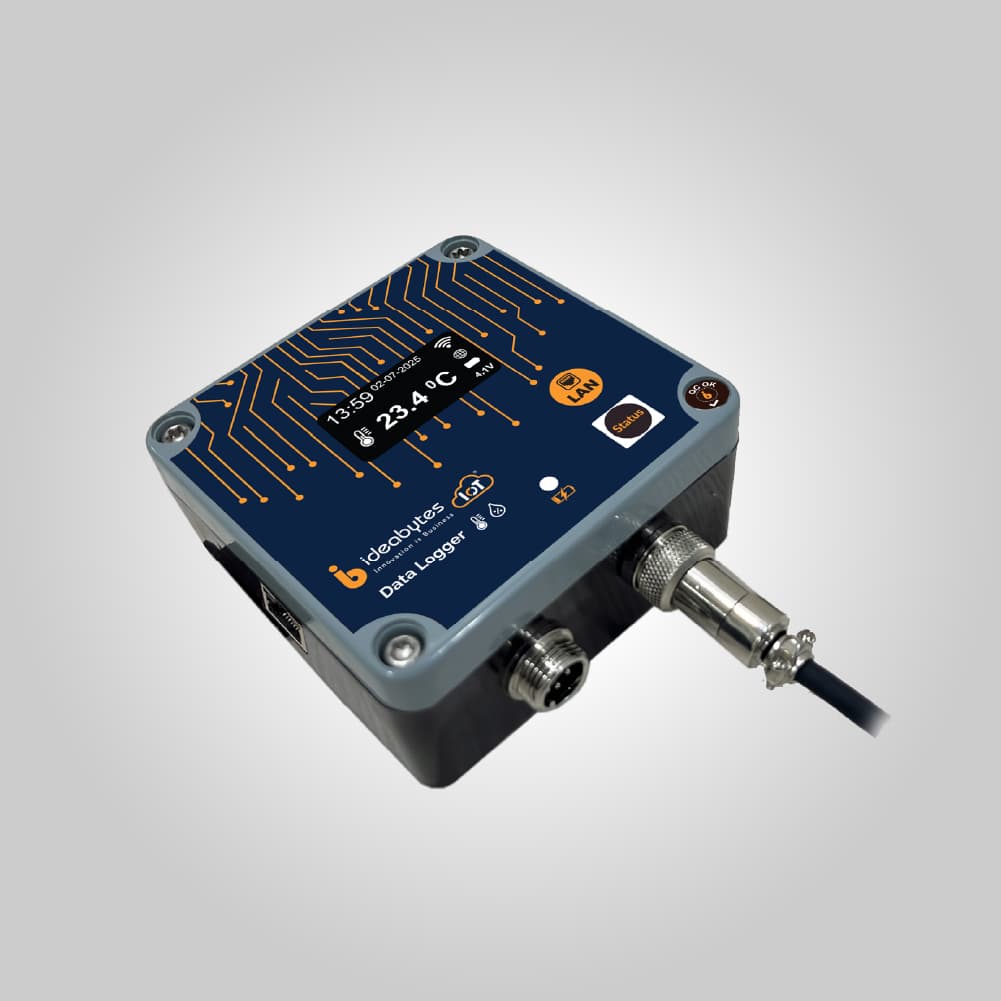
Ethernet Temperature & Humidity Data Logger (−40°C to +120°C)

Wi-Fi Temperature & Humidity Data Logger (−40°C to +120°C)

Wi-Fi 8-Channel PT100 Temperature Data Logger (8 Temperature Channels)

Wi-Fi RS-485 Modbus Interfacing Gateway
4G RS-485 Modbus Interfacing Gateway
Cleanroom monitoring usually covers five parameters: temperature, relative humidity, differential pressure between rooms, airborne particle counts and air changes per hour. The last three belong to the HVAC and qualification side of the facility. Ideabytes IoT covers the first two continuously, and adds CO₂ where a room or incubator area needs it. The loggers and sensors on this page do not measure differential pressure or particles, and they are not a substitute for the particle counting and pressure cascade checks your classification and requalification depend on.
What they do give you is the continuous, time-stamped temperature and humidity record for every room, with alarms, an audit trail and 21 CFR Part 11 compliant PDF reports, on the same platform that monitors your cold rooms, stability chambers and warehouses.
ISO 14644-1 classifies cleanrooms by the airborne particle concentration permitted per cubic metre, from ISO Class 1 to ISO Class 9, and ISO 14644-2 deals with monitoring to show the room keeps performing. Neither standard sets a temperature or humidity number; those limits are chosen by the facility from the product, the process and operator comfort in gowns, and written into the URS and SOPs. Pharmaceutical cleanrooms typically fall in ISO Class 5 to 8 depending on the operation.
EU GMP Annex 1 and WHO GMP expect an environmental monitoring programme with defined limits, alarms, records and review, and Revised Schedule M in India follows the same direction. In practice, auditors commonly look for a continuous record of temperature and humidity per room, evidence that alarms were raised and acted on, and sensors whose calibration and position have been justified. Treat the statements on this page as guidance and confirm the limits with your QA team.
For a single room, airlock or gowning area, a wall-mounted logger with a built-in sensor is the simplest choice. The IBI-WTH50 (Wi-Fi), IBI-ETH50 (Ethernet) and IBI-MTH50 (4G with in-built M2M SIM) read 0 °C to +50 °C with ±0.5 °C accuracy and 0 to 100 % RH with ±2 % RH accuracy, show live values on a 1.3-inch OLED display, log every 15 minutes by default, hold 90 days of readings on board and run for up to 20 hours on the internal battery if power fails. The IP64 enclosure tolerates routine wipe-down.
Where the logger body must stay outside the classified area, use a probe model such as the IBI-ETH120 or IBI-WTH120: the external temperature and humidity probe is rated from -40 °C to +120 °C with the same ±2 % RH specification, so only the probe passes into the room or the chamber while the display and network connection remain in the corridor or plant room.
A suite of six, ten or twenty rooms is cheaper to wire than to populate with individual loggers. The IBI-A-TH485 is a MODBUS RTU temperature and humidity sensor on an RS-485 bus, measuring -30 °C to +70 °C (±0.3 °C between 0 and 60 °C) and 5 to 95 % RH (±2 % RH between 10 and 90 % RH), with selectable 4800, 9600 or 19200 bps and up to 32 nodes on one line. Daisy-chain the sensors through the suite to one IBI-CSC50R (Wi-Fi) or IBI-CSC50RM (4G) gateway, which reads eight parameters by default and sends them to the cloud.
Each sensor then appears as its own channel with its own limits, alarms and trend graph, and the whole suite is one line of reports for batch review. Sensors must be purchased separately from the gateway, and cable runs can be planned around the pressure cascade so no new penetrations are needed.
Some facilities add CO₂ to the room record: cell-culture and incubator rooms, rooms with CO₂ incubators or dry-ice handling, and occupied areas where ventilation performance is tracked. The IBI-A-C485 is an NDIR dual-beam CO₂ sensor on RS-485 MODBUS RTU. It sits on the same RS485 bus and gateway as the temperature-humidity sensors, so CO₂ alarms and reports come from the same dashboard. It is a CO₂ monitor, not a particle counter.
Rooms are only part of the environmental record. Ovens, autoclave jackets, stability chambers, water baths and cold rooms that feed the cleanroom need their own channels. The IBI-WTR8 (Wi-Fi) and IBI-MTR8 (4G) take eight PT100 or PT1000 probes reading from -200 °C to +550 °C on one unit with a 2.4-inch OLED display and up to 18 hours of battery backup, and report to the same platform as the room sensors, so a single report covers the room and the equipment inside it.
Every channel on the platform carries high and low limits with email alerts and app push notifications, with optional SMS, and alerts on loss of power or network. Alarms are kept in an alarm log with an audit trail and can be closed with a CAPA entry. Reports are 21 CFR Part 11 compliant PDFs with trend graphs and MKT, generated on demand or on a daily, weekly or monthly schedule for QA review.
Sensor positions should come from a temperature and humidity mapping study rather than convenience, and the installed system should be qualified through IQ, OQ and PQ before the records are relied on. Ideabytes IoT supplies the loggers, sensors, gateways, calibration certificates on request and the reports; the mapping protocol and the qualification are executed by your validation team or partner. See the temperature mapping guide and the IQ OQ PQ guide linked below.
No. Ideabytes IoT supplies temperature, humidity and CO₂ monitoring: wall-mounted loggers, probe loggers, RS485 MODBUS sensors with gateways and multi-channel PT100 loggers. Differential pressure monitoring and particle counting come from your HVAC, BMS and qualification partners. Our loggers provide the continuous temperature and humidity record that sits alongside those systems.
ISO 14644 classifies rooms by particle concentration and does not fix a temperature or humidity. Limits are set by the facility from the product, the process and operator comfort, and written into the URS and SOPs; many facilities hold a band in the low twenties °C with humidity limited to control microbial growth and static. Confirm the figures with your QA team and your validation partner.
The built-in sensor models (IBI-WTH50, ETH50, MTH50) are wall mountable with an IP64 enclosure that tolerates routine wipe-down, and many facilities install them in Grade C and D rooms. Where your change-control or cleaning regime does not allow equipment inside, use a probe model such as the IBI-ETH120 so only the probe enters the room, or RS485 sensors wired to a gateway outside.
The IBI-A-TH485 RS485 sensor supports up to 32 nodes on one MODBUS line in theory, and the IBI-CSC50R or IBI-CSC50RM gateway reads eight parameters by default, with more configurable. For a typical suite, plan one gateway per corridor or per group of rooms and let us confirm the parameter count and cable plan from your layout.
Yes. The IBI-A-C485 NDIR CO₂ sensor reports over RS-485 MODBUS RTU and sits on the same bus and gateway as the temperature-humidity sensors, so CO₂ appears as another channel with its own limits, alarms and reports. It suits incubator rooms, cell-culture areas and occupied rooms where ventilation is tracked.
The loggers provide what inspectors commonly ask for: a continuous, time-stamped temperature and humidity record per room, alarm logs with corrective action notes, an audit trail and 21 CFR Part 11 compliant PDF reports, with NABL-traceable calibration certificates available on request. Ideabytes IoT manufactures in India and is registered on GeM. Compliance itself depends on your full quality system.
It depends on the number of rooms, whether each room gets its own wall logger or shares an RS485 gateway, whether CO₂ is needed, connectivity (Ethernet, Wi-Fi or 4G), calibration requirements and the software plan. Send us the room list with limits and we will propose the most economical layout with an itemised quote.
Tell us what you store, how many points you need to monitor and which audits you face. Our team in Hyderabad will recommend a setup and send a quotation.