Temperature monitoring
Grain Silo & Grain Storage Temperature Monitoring
A silo for grain storage holds wheat, rice, maize, pulses or oilseeds in bulk for months, and grain temperature is the earliest reliable sign that something is going wrong inside it. A slow rise at one point usually means insects, moisture migration or a developing hot spot well before any smell or visible damage. This page is for silo operators, warehousing corporations, flour and feed mills and agri-logistics companies. Ideabytes IoT supplies 4- and 8-channel PT100 data loggers that read many points in a silo or bag stack, RS485 temperature and humidity sensors for flat warehouses and 4G gateways for remote sites, with alerts and trend reports on one dashboard.
- GeM registered
- 21 CFR Part 11 reports
- Made in India
What goes wrong without monitoring
- Hot spots develop deep inside the grain mass where nobody can see or smell them until the damage is large
- Moisture migrates to the top or walls of the silo as outside temperatures change, causing caking and mould
- Insect activity raises grain temperature locally, and manual spear checks miss most of the mass
- Aeration fans are run by habit rather than by measured grain and air conditions, wasting power or adding moisture
- Remote silos and rural warehouses have no Wi-Fi and are visited only occasionally
- Manual registers do not give warehouse owners, lenders or depositors a reliable condition history
How the system works
- 1Map the storage: silo count, height and diameter, or warehouse floor area, stack layout and commodity
- 2Connect PT100-output temperature cables or probes at several depths to a 4- or 8-channel PT100 logger for each silo or group of stacks
- 3Install RS485 temperature and humidity sensors in flat warehouses and head spaces and read them through a 4G or Wi-Fi MODBUS gateway
- 4Use 4G loggers and the 4G gateway with a built-in M2M SIM at remote silos without Wi-Fi
- 5Set alert thresholds for absolute grain temperature and for a rise over a set period, with SMS and app alerts to the site in-charge
- 6Review weekly trend reports to plan aeration, fumigation and turning, and keep them as the condition record
Standards and regulators
- WDRA
- FCI
- FSSAI
- FDA 21 CFR Part 11
Recommended loggers for grain silos
Selected from the Ideabytes range for this application. All models report to one cloud dashboard with SMS, email and call alerts.
Showing 8 products

IBI-MTR8 | 4G M2M 8 Channel PT100 Temperature Data Logger (8 Temperature)
Measuring Range PT100 : -200°C to 550°C | PT1000 : -200°C to 550°C (Optional)
- •4G LTE CAT1 Technology with In-built M2M SIM Connectivity
- •0.5°C (0.05% of Full Scale) Accuracy
- •2.4" 128X64 OLED monochrome Graphical Display

IBI-WTR8 | Wi-Fi 8 Channel PT100 Temperature Data Logger (8 Temperature)
Measuring Range PT100: -200°C to 550°C | PT1000: -200°C to 550°C (Optional)
- •Wi-Fi 802.11 b/g/n 2.4 GHz Connectivity
- •0.5°C (0.05% of Full Scale) Accuracy
- •2.4" 128X64 OLED monochrome Graphical Display
IBI-MTR4 | 4G M2M 4 Channel PT100 Temperature Data Logger (4 Temperature)
Measuring Range PT100 : -200°C to 550°C | PT1000 : -200°C to 550°C (Optional)
- •4G LTE CAT1 Technology with In-built M2M SIM Connectivity
- •0.5°C (0.05% of Full Scale) Accuracy
- •2.4" 128X64 OLED monochrome Graphical Display
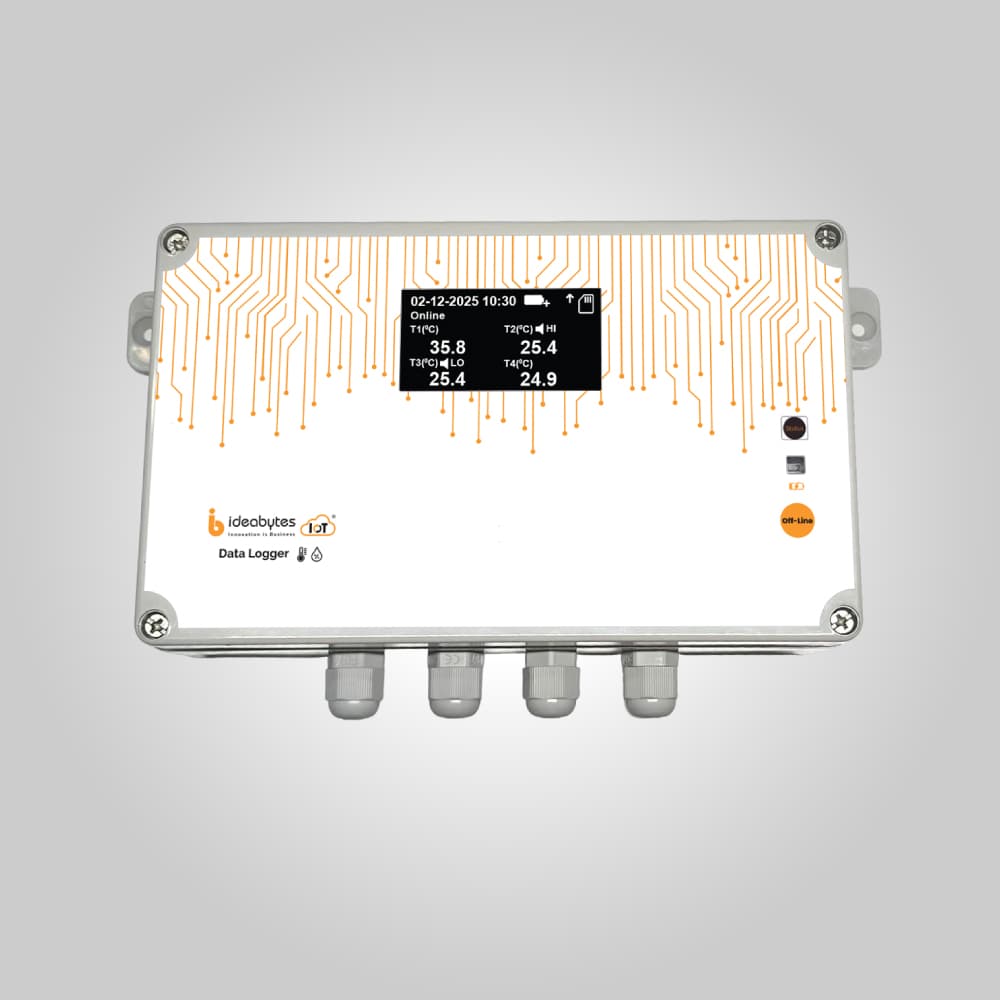
IBI-OTR8 | Offline 8 Channel Temperature Data Logger
Measuring Range PT100 : -200°C to 550°C | PT1000 : -200°C to 550°C (Optional)
- •Plug & Play Device
- •0.5°C (0.05% of Full Scale) Accuracy
- •2.4" 128X64 OLED monochrome Graphical Display

MODBUS RS485 Temperature and Humidity Sensor
The IBI-TH485 temperature and humidity sensor is designed based on the RS-485 communicationinterface, compatible with the standard Modbus-RTU protocol, and can be connected to the Modbus network to achieve temperature and humidity measurement and monitoring.
- •Low power consumption
- •Fully calibrated
- •High precision and good consistency
 Popular
IBI-MTH120 | 4G M2M Temperature & Humidity Data Logger
Measuring Range from -40°C to +120°C
- •4G LTE CAT1 Technology with In-built M2M SIM Connectivity
- •± 0.5°C (-10°C to +50°C) Accuracy

IBI-CSC50RM | 4G RS485 MODBUS Interfacing Gateway
8 Default Parameters (Configuration Charges additional)
- •Can Communicate up to 15 RS-485 MODBUS RTU enabled Devices
- •Maximum of 30 parameters can be monitored based on requirement (Single or Multiple RS485 Devices)

IBI-MT350 | 4G M2M Temperature Data Logger
Measuring Range from -200°C to +350°C
- •4G LTE Cat1/2G fallback Connectivity
- •± 0.5°C (-10°C to +50°C) Accuracy
Why temperature is the earliest sign of grain spoilage
Stored grain is alive. It respires slowly, and so do the insects and moulds that live in it. When insects multiply or moisture collects in one part of a grain storage silo, that pocket heats up. The heat drives more moisture, which helps more mould and insects, and the hot spot spreads. By the time the grain smells musty or cakes, a large volume may already be damaged.
A rise of a few degrees at one sensor, compared with the others at the same depth, is usually the first measurable signal. That is why silo temperature monitoring at many points, recorded continuously and compared over weeks, is one of the most useful grain storage techniques available.
Grain storage temperature and moisture: typical safe-storage guidance
Safe storage depends on grain moisture and grain temperature together; drier, cooler grain keeps longer. The points below are general guidance, not a specification for any commodity. Follow the moisture and storage norms set by your buyer, FCI or state warehousing corporation for each grain.
- Keep grain as cool as practical; below roughly 15 to 20 °C slows insect breeding markedly, although this is hard to reach in much of India without aeration
- Dry grain to its safe storage moisture before it goes in; higher-moisture grain needs cooler conditions and closer watching
- Watch for any sensor that rises faster than its neighbours, not only for a fixed limit
- Run aeration fans when outside air is cooler than the grain and not so humid that it adds moisture
- Check head space and wall zones closely, where condensation and moisture migration start
Multi-point silo temperature monitoring with PT100 loggers
A single probe cannot represent a silo holding thousands of tonnes. Silo operators usually hang temperature cables from the roof with sensing points at several depths, or push probes into bag stacks at different heights. The IBI-MTR8 and IBI-WTR8 read up to eight PT100 inputs, and the IBI-MTR4 reads four, each with 2-, 3- or 4-wire PT100 support, an accuracy of 0.5 °C and an OLED display. The IBI-OTR8 offline 8-channel logger suits temporary surveys or sites that only need periodic downloads.
Ideabytes IoT supplies the loggers and PT100 probes. Silo temperature cables themselves are usually third-party products; PT100-output cables can connect to our multi-channel loggers, so check the cable output type when you plan the system. The IBI-MT350 single-channel 4G logger with a PT100 probe suits a single monitoring point, such as a small bin or a dryer outlet.
Cable and probe placement in silos and bag stacks
In a bulk silo, temperature cables are usually hung from the roof so that sensing points sit at regular depths, with one cable near the centre and others between the centre and the wall in larger silos. The centre and the upper layers tend to heat first, while wall zones are where moisture from condensation collects. Record the depth of every sensing point so an alert tells the operator exactly where to look.
In bag stacks, probes pushed into the middle of the stack at low, middle and high levels give a useful picture of grain temperature. Add one ambient point per bay to compare grain with air. Protect probe leads from rodents and forklifts, and label each channel on the logger so readings stay traceable after restacking.
Warehouse grain storage monitoring and humidity
In flat warehouses and godowns, grain is stored in bag stacks rather than bulk silos, and the air around the stacks matters as much as the grain inside them. High humidity during the monsoon lets bags take up moisture; poor ventilation traps it. The IBI-A-TH485 RS485 temperature and humidity sensor can be placed at several positions in a warehouse and read through one IBI-CSC50RM 4G or IBI-CSC50R Wi-Fi MODBUS gateway, each handling up to 15 RS485 devices and up to 30 parameters.
Where a simpler setup is enough, a stand-alone IBI-MTH120 4G temperature and humidity logger per warehouse bay records ambient conditions and sends alerts. Probes pushed into selected stacks and connected to a PT100 multi-channel logger add grain temperature to the same dashboard.
Grain storage silos in India: remote sites and 4G
Grain storage silos in India are spread across procurement areas in Punjab, Haryana, Madhya Pradesh, Uttar Pradesh and other states, often at rail sidings and rural mandis far from reliable broadband. The key stakeholders include the Food Corporation of India, the Central and State Warehousing Corporations, private silo operators under public-private partnership projects, and warehouses registered with the Warehousing Development and Regulatory Authority (WDRA).
For these sites, 4G loggers and the IBI-CSC50RM gateway with a built-in M2M SIM send data without any site network. Loggers keep recording through power cuts and upload when the connection returns, so a regional manager can see every silo in one place.
Alerts, trend reports and automated grain storage
Alerts can be set on absolute grain temperature and on a rise over a defined period, so a slow-developing hot spot is flagged early. SMS and app notifications go to the site in-charge first, then to the regional manager if the alert is not acknowledged. Every alert and response is logged.
Weekly trend reports show each sensing point over time, which helps plan aeration, fumigation and turning, and gives depositors and lenders a condition history for the stock. In automated grain storage projects, the MODBUS gateway can also bring RS485 sensor readings into one system alongside the loggers. Ideabytes IoT is registered on GeM, manufactures in India and provides 21 CFR Part 11 compliant reports.
Frequently asked questions
Why monitor temperature in a silo for grain storage?
Insects, mould and moisture migration all raise grain temperature locally before damage is visible. Continuous readings at several depths show a hot spot while it is still small, so aeration, turning or fumigation can be done in time instead of discovering spoiled grain at unloading.
Can your loggers connect to silo temperature cables?
Our IBI-MTR4, IBI-MTR8, IBI-WTR8 and IBI-OTR8 loggers accept PT100 inputs (2, 3 or 4 wire). Silo temperature cables are usually supplied by third parties, and PT100-output cables can connect to these loggers. Check the cable's sensor type and number of points when planning channel counts.
What temperature should stored grain be kept at?
Cooler is better. As general guidance, keeping grain below roughly 15 to 20 °C slows insect breeding, and the safe temperature depends on grain moisture. Follow the moisture and storage norms for your commodity from your buyer, FCI or the state warehousing corporation.
Do you monitor humidity in grain warehouses as well?
Yes. RS485 temperature and humidity sensors or 4G temperature and humidity loggers record ambient conditions in flat warehouses and head spaces, which helps decide when to ventilate and shows monsoon humidity risks to bag stacks.
How much does grain silo temperature monitoring cost?
It depends on the number of silos or warehouse bays, the number of sensing points per silo, whether you already have PT100-output cables, 4G or Wi-Fi connectivity, humidity sensors, the software plan and calibration. Share your silo sizes and layout and we will prepare a quotation.
Is the system suitable for FCI, CWC or WDRA-registered warehouses in India?
Yes. Continuous temperature and humidity records, alarm logs and trend reports support the stock-condition records these operators and their depositors expect. Ideabytes IoT is registered on GeM for government procurement, manufactures in India and provides calibration certificates on request.
Related reading
Applications
From the blog
Plan monitoring for your site
Tell us what you store, how many points you need to monitor and which audits you face. Our team in Hyderabad will recommend a setup and send a quotation.